
Articles·Analysis··11 min read
Europe Bans Offset‑Based “Carbon Neutral” Claims in September. Here’s What Replaces It.
From 27 September 2026, telling a consumer a product is carbon neutral on the basis of offsetting becomes an unfair commercial practice across the EU — banned in all circumstances. What the ban covers, what survives it, and the disclosure regime taking its place.
From 27 September 2026, telling a consumer that a product is carbon neutral on the basis of offsetting becomes an unfair commercial practice in the European Union. Not “unfair unless you can justify it.” Unfair in all circumstances, with no case-by-case assessment and no defense available. Essentially, products can no longer claim to be “carbon neutral”.
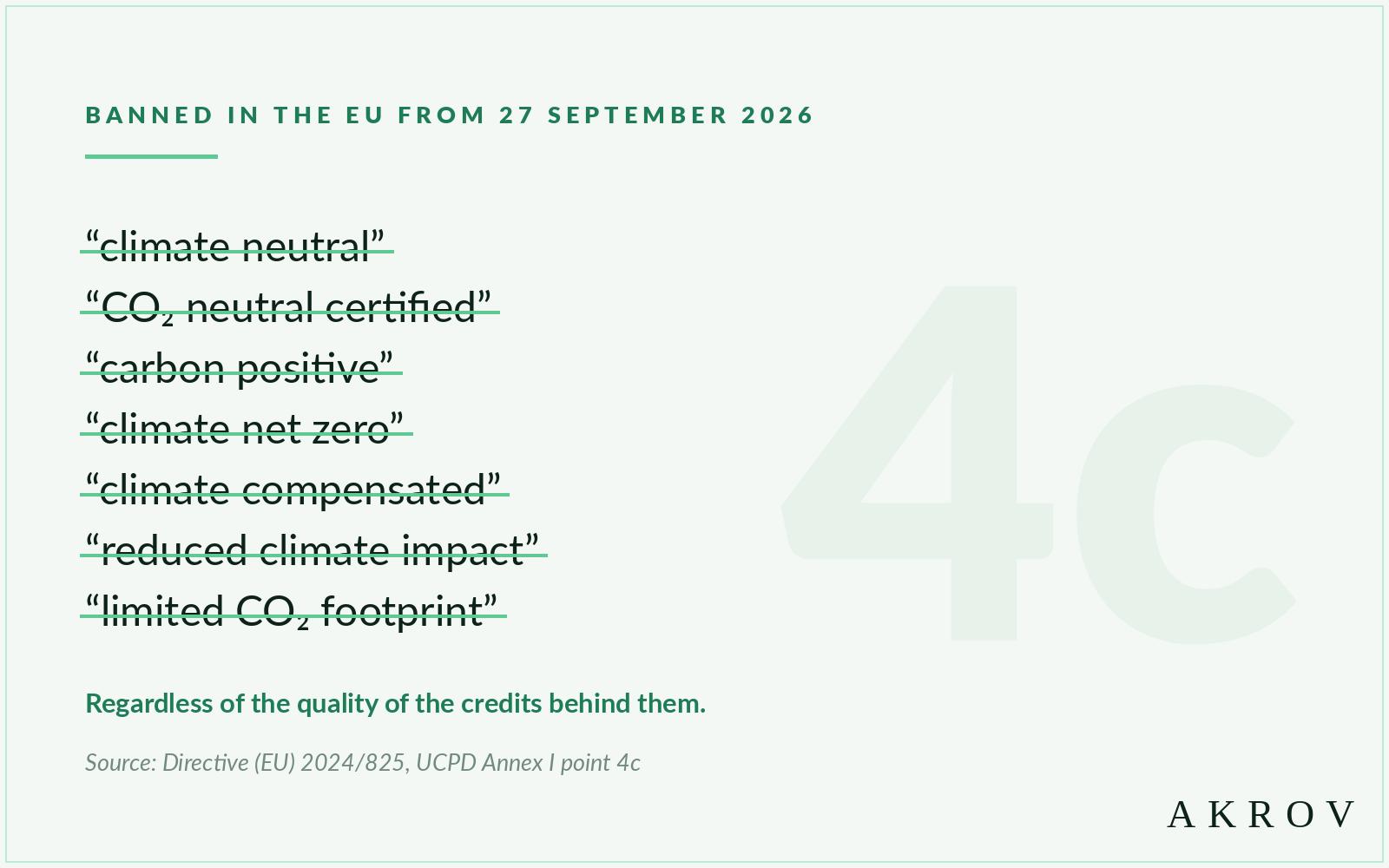
The mechanism is Directive (EU) 2024/825, the Empowering Consumers for the Green Transition Directive, adopted in February 2024. It inserts a new item into Annex I of the Unfair Commercial Practices Directive; Annex I being the blacklist, the short list of practices banned outright rather than assessed on their facts. The new point 4c reads:
“Claiming, based on the offsetting of greenhouse gas emissions, that a product has a neutral, reduced or positive impact on the environment in terms of greenhouse gas emissions.”
The recitals name the phrases it has in mind: climate neutral, CO2 neutral certified, carbon positive, climate net zero, climate compensated, reduced climate impact, limited CO2 footprint. The quality of the credits behind the claim is irrelevant. A premium removal and a discredited avoided-deforestation credit produce the same outcome, because the objection is not to the credit. It is to the equivalence.
One caveat on enforcement. This is a directive, so it bites through national implementing law, and transposition has been uneven. The deadline of 27 March 2026 passed with several member states still not done. The rule is settled; the date on which any particular regulator can act on it is not uniform.
Worth noting what is not driving this. The Green Claims Directive, the more ambitious substantiation regime, has been dormant since the Commission announced its intention to withdraw the proposal in June 2025 and then never formally withdrew it. The rule that actually lands in September has been on the calendar for two and a half years.
What the ban actually covers, precisely
Worth getting right, because most of what has been written about it is wrong in one direction or the other.
It is product-level. “Product” includes services under the UCPD, so a carbon neutral flight, delivery or bank account is caught alongside a carbon neutral bottle. But the Commission’s own guidance is explicit that point 4c does not apply to claims made at company level: “our company is carbon neutral” is not caught by this item.
That sounds like a large gap, and it is smaller than it looks. Company-level claims fall out of 4c and into the neighbouring blacklist items. Point 4a bans generic environmental claims where the trader cannot demonstrate recognised excellent environmental performance, and the Commission lists “carbon-neutral” and “climate neutral” as examples of exactly that. Point 4b bans environmental claims about an entire product or an entire business when they concern only one aspect or activity. And Article 6(2)(d) requires any forward-looking neutrality commitment to rest on a detailed, realistic implementation plan that is independently verified and published. The product-level claim is banned outright; the company-level claim survives that specific ban and lands in a substantiation regime most companies making it today would not pass.
It is business-to-consumer only. The Unfair Commercial Practices Directive has never governed B2B dealings, and this amendment did not change that. Corporate sustainability reporting is typically outside scope too, because it is mandatory and addressed to investors, but the Commission is clear that lifting a figure out of a sustainability report into consumer marketing turns it back into a commercial practice.
The penalty figure everyone quotes is not quite right. You will read that breaches carry fines of up to 4% of annual turnover. That number comes from Article 13(3) of the Unfair Commercial Practices Directive, and it is a floor on the maximum fine member states must make available, not a cap. It applies to penalties imposed under coordinated enforcement actions for widespread cross-border infringements, and it is calculated on turnover in the member states concerned, not global turnover. Ordinary national cases run on the general requirement that penalties be effective, proportionate and dissuasive, which in several member states is harsher.
What is still allowed
The directive is careful here, and the exact language is what matters. Recital 12 states that the prohibition “should not prevent companies from advertising their investments in environmental initiatives, including carbon credit projects, as long as they provide such information in a way that is not misleading and that complies with the requirements laid down in Union law.”
A neutrality claim built on the product’s own lifecycle also survives. Certain biomass-based products genuinely store more carbon than their value chain emits, and saying so is permitted if the lifecycle assessment holds up.
So a company can still buy credits, and can still say it bought them. What it cannot do is convert that purchase into a statement about the product’s own footprint. “We finance verified restoration in Central America” survives. “This product is carbon neutral” does not. The credit is intact. The arithmetic that turned a credit into a neutrality claim is what has been banned.
What actually dies
Here is the part that gets far less attention. For fifteen years, a large share of what the voluntary market sold was not really a tonne. It was more like a weak sentence.
The credit was an input into a marketing asset, presented as a label, a landing page, a line on a package; and the value of the input was set by the value of the asset. Which is why quality mattered less than it should have. A communications team was the effective quality control, and a communications team’s test is whether a claim can be defended in a press cycle, not whether it survives an audit.
That specific asset is now gone at product level, and constrained at company level. Now companies need to be careful about how far they push the consequence: nobody can certify what share of retirements was attached to EU consumer-facing product claims, because that data does not exist. What is measurable is how concentrated the market always was. In one study of 89 large multinationals, those 89 companies alone accounted for roughly a quarter of all credits retired in 2022. Among them, offsetting spend ran at around 1% of capital expenditure for even the heaviest users. The voluntary market was never as broad or as load-bearing as its headline volumes suggested.
What replaces it
Three things, pointing the same direction.
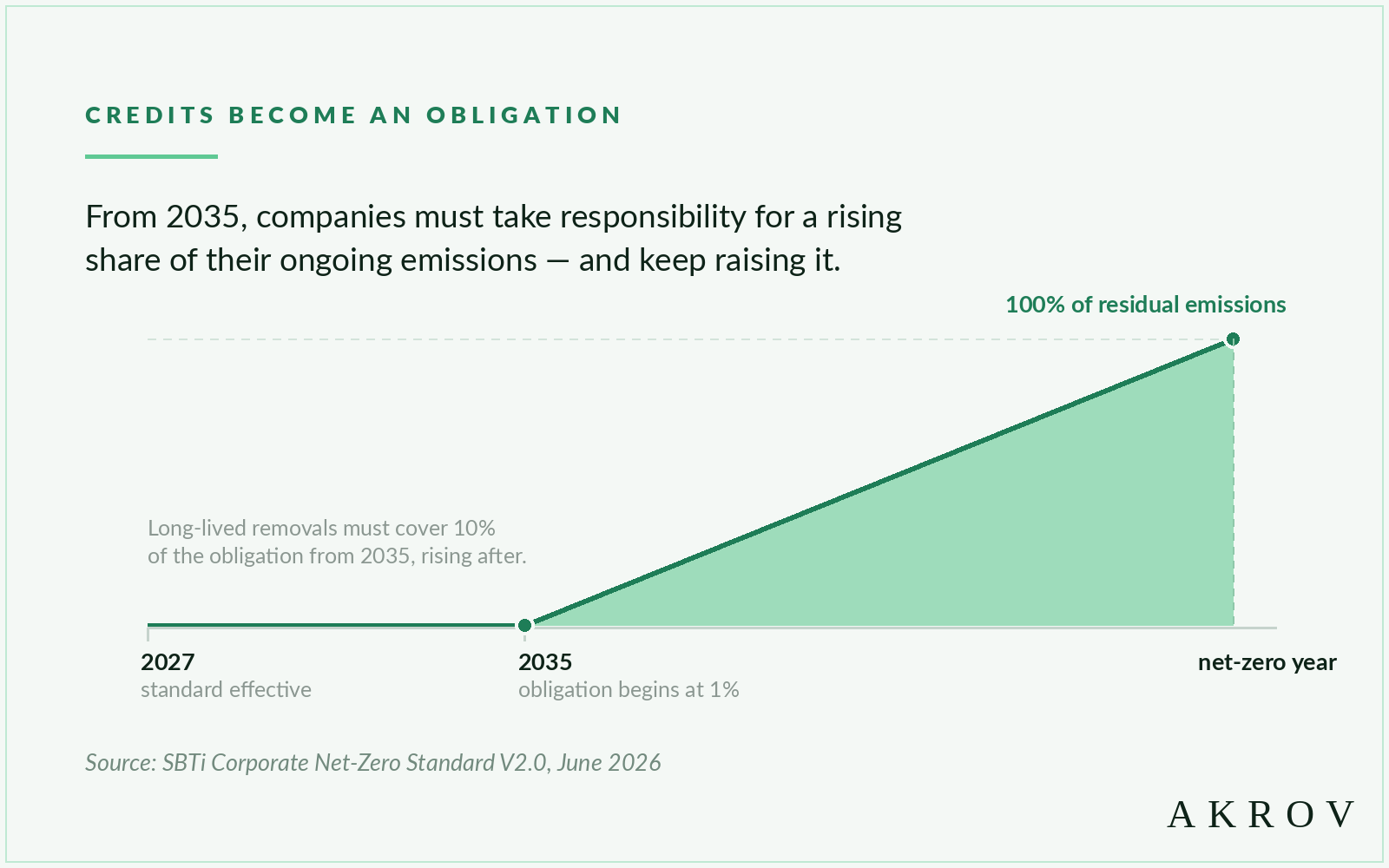
SBTi’s Corporate Net-Zero Standard V2.0. Published on 11 June 2026 after two rounds of pilot testing, effective 1 February 2027, and mandatory for all new target submissions after 31 January 2028. It introduces an Ongoing Emissions Responsibility framework, replacing the vague “beyond value chain mitigation” label with a structured route for credits. It is now accounted separately from a company’s inventory and target progress rather than inside them. Recognition is optional until 2035. From then, companies above SBTi’s size thresholds must take responsibility for a rising share of ongoing emissions, starting at 1% and reaching full neutralisation of residual emissions at their net-zero year, with a durability requirement on long-lived removals beginning at 10% in 2035. Credits stop being a marketing input and become a disclosed obligation with a schedule attached.
Sustainability reporting. Under the revised European reporting standards adopted in July 2026, carbon credits are disclosed in their own datapoint, separately from gross emissions, and netting credits against the inventory is not permitted. The revision trimmed some of what had to be itemized, and added something more interesting in its place: disclosure of non-permanence and reversal risk. Fewer companies will be required to report, as the Omnibus package raised the threshold to 1,000 employees and €450 million in turnover for financial years beginning in January 2027. For those that remain in scope, carbon credit disclosures will appear in an assured report reviewed by an independent auditor rather than a marketing team.
Contribution rather than compensation. VCMI’s Claims Code, in its April 2025 version, refuses to let credits count towards within-value-chain reduction targets and offers no carbon neutral tier, framing credits instead as financing climate action beyond the value chain. It is not a purity standard, its highest tier still requires retiring credits equal to at least 100% of remaining emissions, and its companion Scope 3 code allows credits to close up to a quarter of the scope 3 gap until 2040, which critics reasonably read as offsetting under another name. But the direction of travel is the same as the ECGT’s: stop asserting equivalence, start describing what you paid for.
The through-line
Europe is forcing a trade. The market gives up a claim it could not substantiate, and takes on an obligation it has to document.
Those two things behave differently. Marketing tolerates ambiguity, because ambiguity is often the point. Accounting has no tolerance, because a number in an assured report has to survive a reviewer who has no stake in the answer being flattering. A sentence in an advertisement was checked by the people who wrote it. A line in a disclosure table is checked by someone paid to doubt it.
The result is a narrower market with a much higher evidentiary floor. That is not a downgrade. A market where fewer buyers purchase for reasons that hold up is worth more than a larger one built on a claim a regulator has just declared misleading in all circumstances.
What it means
If you buy credits in the EU, the work between now and September is unglamorous: it will require an audit of every consumer-facing surface — packaging, product pages, checkout flows, advertising — for neutrality language built on offsetting. Product-level claims are the urgent ones. Company-level claims are not banned outright, but if you cannot point to a verified implementation plan behind yours, you are relying on a distinction that will not hold for long.
If you supply credits, the test is now whether your tonne can populate a disclosure table without a footnote apologizing for uncertainty. Volume, credit type, standard, and most importantly, what happens if the carbon comes back. Credits that can answer that will be bought by companies with a documented obligation. Credits that cannot were mostly sellable to companies with a sentence to write, and that sentence stops being available on 27 September.
Sources
- Directive (EU) 2024/825 (ECGT / EmpCo) — adopted 28 February 2024, applies from 27 September 2026; new UCPD Annex I points 2a, 4a, 4b, 4c, 10a; Recital 12 phrase list and carve-out for advertising investments in carbon credit projects: EUR-Lex
- Commission Q&A, 27 November 2025 — B2C-only scope; 4c does not reach company-level claims; “carbon-neutral” listed as a generic claim under 4a; sustainability reports typically out of scope; lifecycle-based neutrality claims permitted: European Commission FAQ (PDF)
- Uneven transposition as of mid-2026: CMS EmpCo implementation tracker
- Penalties — UCPD Article 13(3) as amended by Directive (EU) 2019/2161; Article 21 CPC Regulation (EU) 2017/2394: EUR-Lex, consolidated UCPD
- Green Claims Directive dormancy: Latham & Watkins
- SBTi Corporate Net-Zero Standard V2.0: Ongoing Emissions Responsibility chapter; overview
- Revised ESRS adopted 3 July 2026 — carbon credits datapoint renumbered E1-7 → E1-9, several itemised fields removed, non-permanence and reversal disclosures added: Commission delegated act (PDF)
- Omnibus I, Directive (EU) 2026/470: Council press release
- VCMI Claims Code v3.0 (April 2025): PDF; Scope 3 Action Code: VCMI
- 89 multinationals, quarter of 2022 retirements, ~1% of capex: Stolz & Probst, Nature Communications 16:7963 (2025)