
Articles·Analysis··8 min read
Europe Banned Offsets. Now It’s Buying Them Back — On Its Own Terms.
The European Commission proposes to buy 250 million tonnes of certified carbon removals inside the EU ETS — €35.7–55.5 billion from the jurisdiction that banned offsets. What changed, and what it means for anyone building supply.

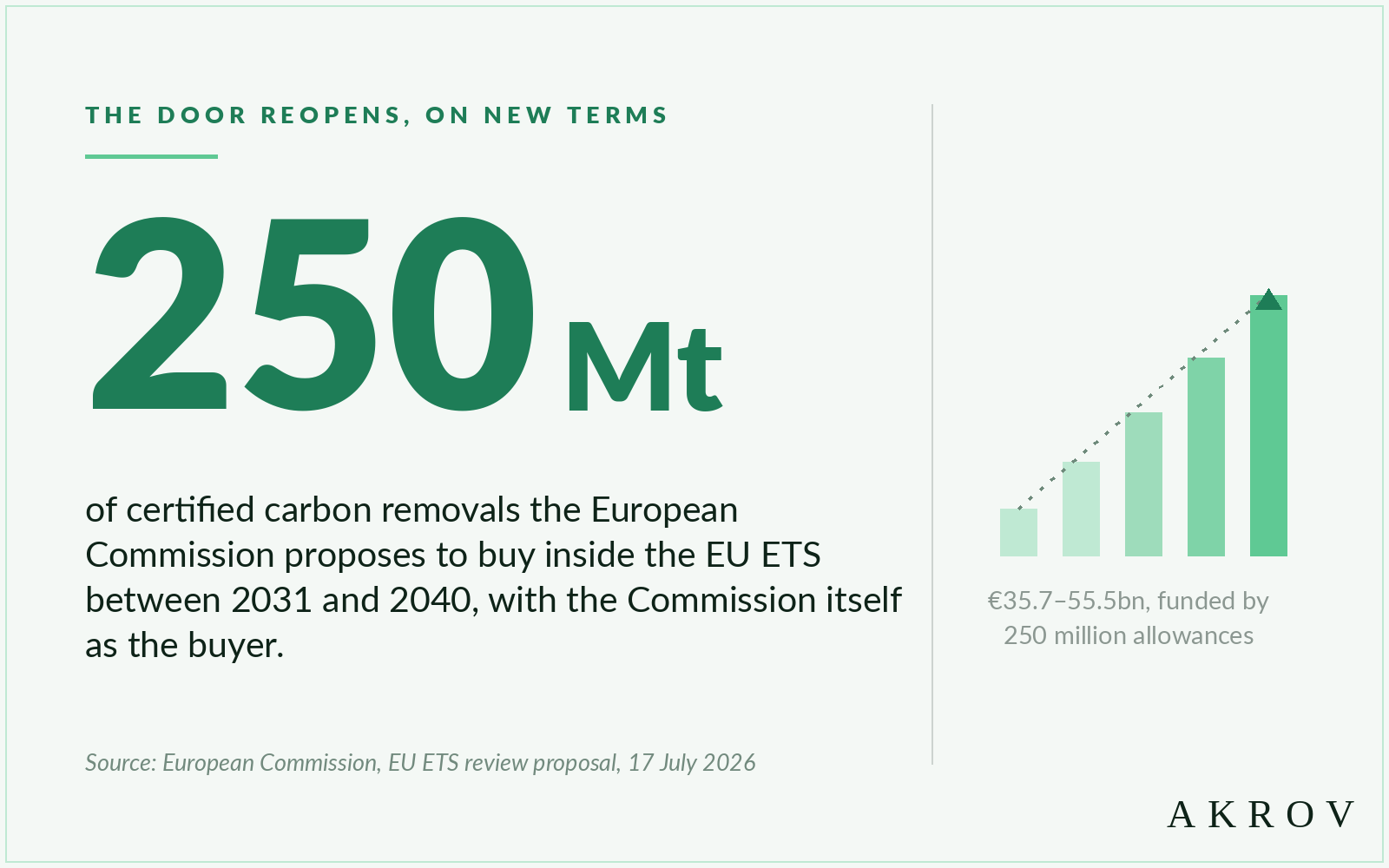
Ten days ago, on 17 July 2026, the European Commission published its proposal for the next phase of the EU Emissions Trading System. Buried in a long and technical document is a decision the carbon market has been waiting on for a decade: Europe intends to buy carbon removals inside its compliance market, at scale. The Commission would raise the ETS cap by 250 million allowances and use the proceeds — an estimated €35.7 to €55.5 billion between 2031 and 2040 — to purchase 250 million tonnes of certified removals, acting as the central buyer itself.
To understand why that is remarkable, you have to remember that Europe is the jurisdiction that banned offsets in the first place.
The market Europe walked away from
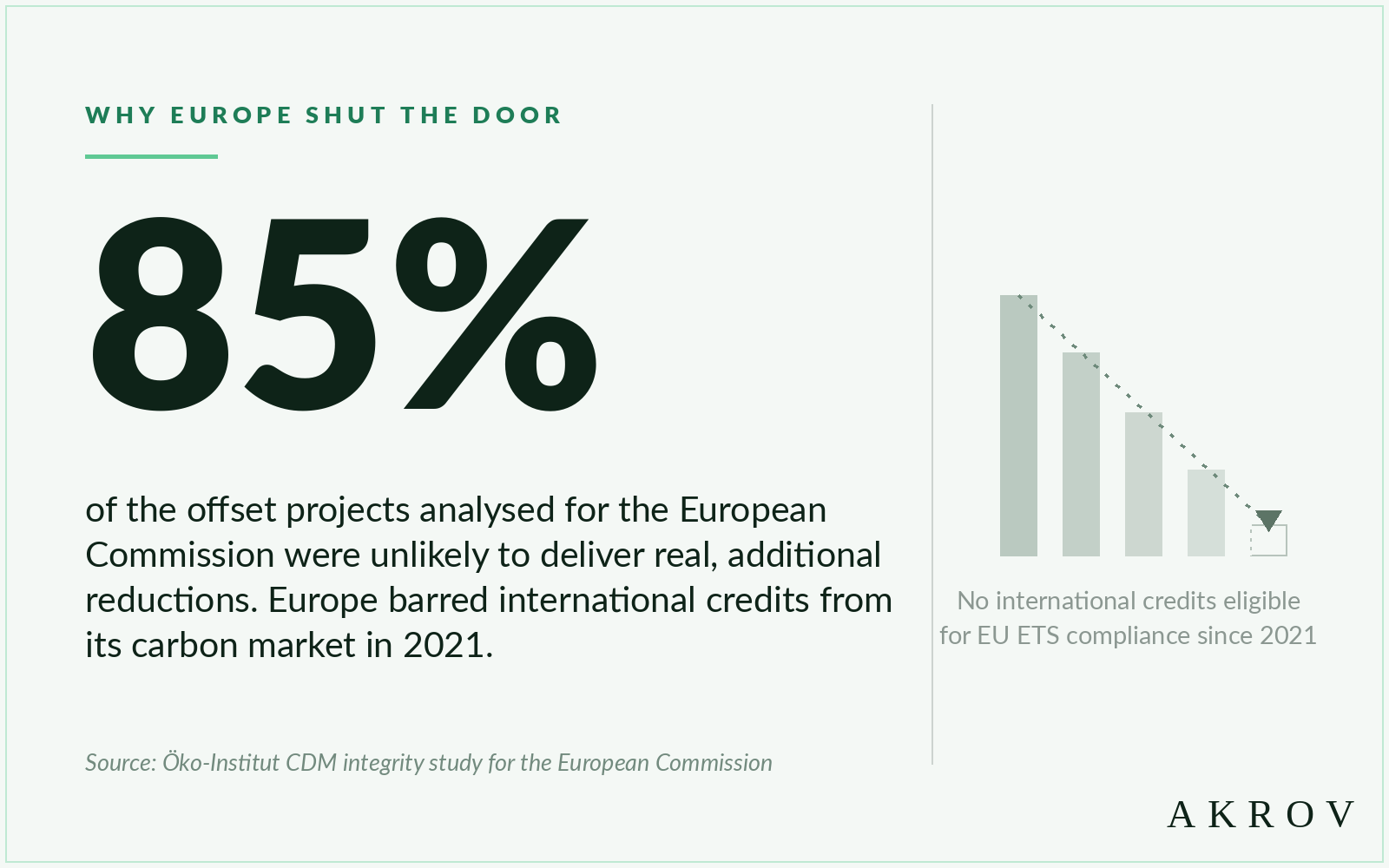
In the 2000s, the EU ETS was the largest single source of demand for international offset credits. European installations could meet compliance obligations with credits from the Clean Development Mechanism, and they did, in enormous volume. Then the evidence came in. Study after study found that a large share of those credits did not represent real reductions — the most cited analysis concluded that around 85 percent of CDM projects were unlikely to be additional. Prices collapsed. Europe restricted eligibility, then closed the door entirely: since Phase 4 began in 2021, no international credits count towards EU ETS compliance at all.
That ban is the single most important fact about the European offset market, and it is the reason the market has spent fifteen years as a purely voluntary, marketing-driven affair on the continent. Europe tried offsets at industrial scale, got burned, and rebuilt its climate policy around domestic reductions instead.
So when Brussels starts writing offsets back into law, it is worth asking what changed.
Three doors opening at once
The climate law reopened international credits. In December 2025, Parliament and Council agreed a binding 2040 target of a 90 percent net reduction against 1990. The compromise that got it over the line was a flexibility: from 2036, high-quality international credits under Article 6 of the Paris Agreement may cover up to 5 percent of 1990 net emissions, meaning at least 85 percent of the effort must still happen inside the EU. The Council gave final approval in March 2026. The July ETS proposal puts money behind it — revenue from a further 260 million allowances earmarked for Article 6 purchases between 2036 and 2040.
A government-issued definition of a credible tonne now exists. The Carbon Removals and Carbon Farming Regulation moved from framework to operating system this year. In February 2026 the Commission adopted the first certification methodologies for permanent removals — direct air capture with storage, bio-based capture with storage, and biochar. In July it adopted three more for carbon farming: mineral soils and agroforestry, peatland rewetting, and afforestation. This is the first time any government has published a legal specification for what counts as a verified removed tonne, and it is now the gatekeeper for everything downstream. The ETS proposal buys only CRCF-certified units.
The consumer-facing offset claim is being outlawed. From 27 September 2026, the Empowering Consumers Directive blacklists claims that a product is carbon neutral on the basis of offsetting, regardless of the credits’ quality or standard, with penalties reaching 4 percent of EU turnover. The separate Green Claims Directive was withdrawn in 2025, but the effect is the same in the place it matters: you can no longer buy a credit and print a claim on a package.
The trajectory, stated plainly
Put those three together and the direction is unambiguous. The European offset market is not growing or shrinking. It is migrating — out of marketing budgets and into compliance ledgers.
The old European buyer was a brand, purchasing credits to support a claim, with the marketing department as the effective quality control. That buyer is being legislated out of existence. The new European buyer is a regulated installation meeting an obligation, or the European Commission itself running a multi-billion-euro procurement. Their quality control is a legal certification standard and an auditor.
That changes what a credit has to be. A marketing credit had to be defensible in a press cycle. A compliance credit has to be defensible in an administrative proceeding, years later, against a regulator with subpoena power and no interest in your narrative. The bar is not higher by degree. It is a different kind of bar.
What the proposal excludes tells you more than what it includes
Here is the detail that should concentrate the mind of anyone building supply. Of the three permanent CRCF pathways already certified, the ETS proposal admits only two — capture with geological storage. Biochar was left out despite a favourable assessment in the Commission’s own impact work. Carbon farming and temporary nature-based removals are excluded until a review in 2034 at the earliest.
The stated reason is not that these pathways don’t sequester carbon. It is that geological storage arrives with a pre-existing regime for monitoring and long-term liability, and the others do not. Europe let in the pathways where the evidence chain and the accountability chain were already built, and held back the ones where they weren’t.
That is the whole lesson of the last fifteen years compressed into one drafting decision. Eligibility now tracks verifiability. Not ambition, not carbon logic, not press coverage — the ability to prove the tonne and stay on the hook for it.
There is a real cost to this caution, and it is worth naming. The Commission’s own cost assumptions look optimistic: the proposal depends on bio-based capture falling below €200 per tonne by 2036, when unsubsidised projects cost well over €300 today. If those numbers don’t land, Europe either buys less than it promised or widens the gate to cheaper pathways. The most likely fix is the third option — admitting biochar, and eventually nature-based removals that can demonstrate contracted, monitored durability. In other words, the door opens further for exactly the pathways that can produce a permanence story a regulator will accept.
What this means if you are building
For everyone working on ocean, coastal, and nature-based carbon in Europe, the message is not discouraging. It is specific. The compliance market is being built now, the criteria are being written now, and the gate is measurement and liability rather than category. Pathways currently outside the ETS are outside because nobody has yet shown a monitoring and durability regime a regulator can enforce — which is a solvable engineering and evidence problem, and a far better problem to have than a credibility one.
The European offset market spent a decade in exile for a reason. It is coming back because the continent is building the one thing it lacked the first time: a legal standard for what counts as proof. Whoever can meet that standard for their pathway gets access to the largest carbon market in the world. Whoever can’t will be selling into a market that Europe has just made illegal to advertise.
Sources
- EU ETS review proposal, 17 July 2026 — cap raised by 250M allowances, Commission as central purchaser, €35.7–55.5bn budget, DACCS and BioCCS only, biochar and nature-based excluded until 2034 review, 260M allowances for Article 6 credits 2036–2040: Carbonfuture analysis; official proposal
- ICAP summary of the ETS review proposal: ICAP
- 2040 target agreed 10 Dec 2025 (90% net reduction; international credits up to 5% of 1990 net emissions from 2036; ≥85% domestic): Council press release
- Final Council approval, 5 March 2026, and ETS2 postponed to 2028: Council press release
- CRCF first permanent removal methodologies adopted 3 Feb 2026 (DACCS, BioCCS, biochar): European Commission
- CRCF carbon farming methodologies adopted 10 July 2026 (mineral soils/agroforestry, peatland rewetting, afforestation): European Commission
- ECGT Directive: offsetting-based carbon neutral claims blacklisted from 27 Sept 2026, penalties up to 4% of EU turnover; Green Claims Directive withdrawn 2025: Seedling; Senken
- EUA price range €60–95 over 2025–26, ~€72 April 2026: Homaio
- CBAM definitive period from 1 Jan 2026; CBAM factor phasing out free allocation 97.5% (2026) → 14% (2033): European Commission / Access2Markets
- CDM integrity: Öko-Institut study for the European Commission found 85% of projects analysed, and 73% of potential 2013–2020 CER supply, had a low likelihood of being additional and not over-estimated: Study on the Integrity of the CDM (Commission, 2016)
- No international credits are eligible for EU ETS compliance in Phase 4 (from 2021): ICAP, EU ETS factsheet