
Articles·Analysis··7 min read
The Carbon Market Had a Trust Problem. Here’s What’s Fixing It.
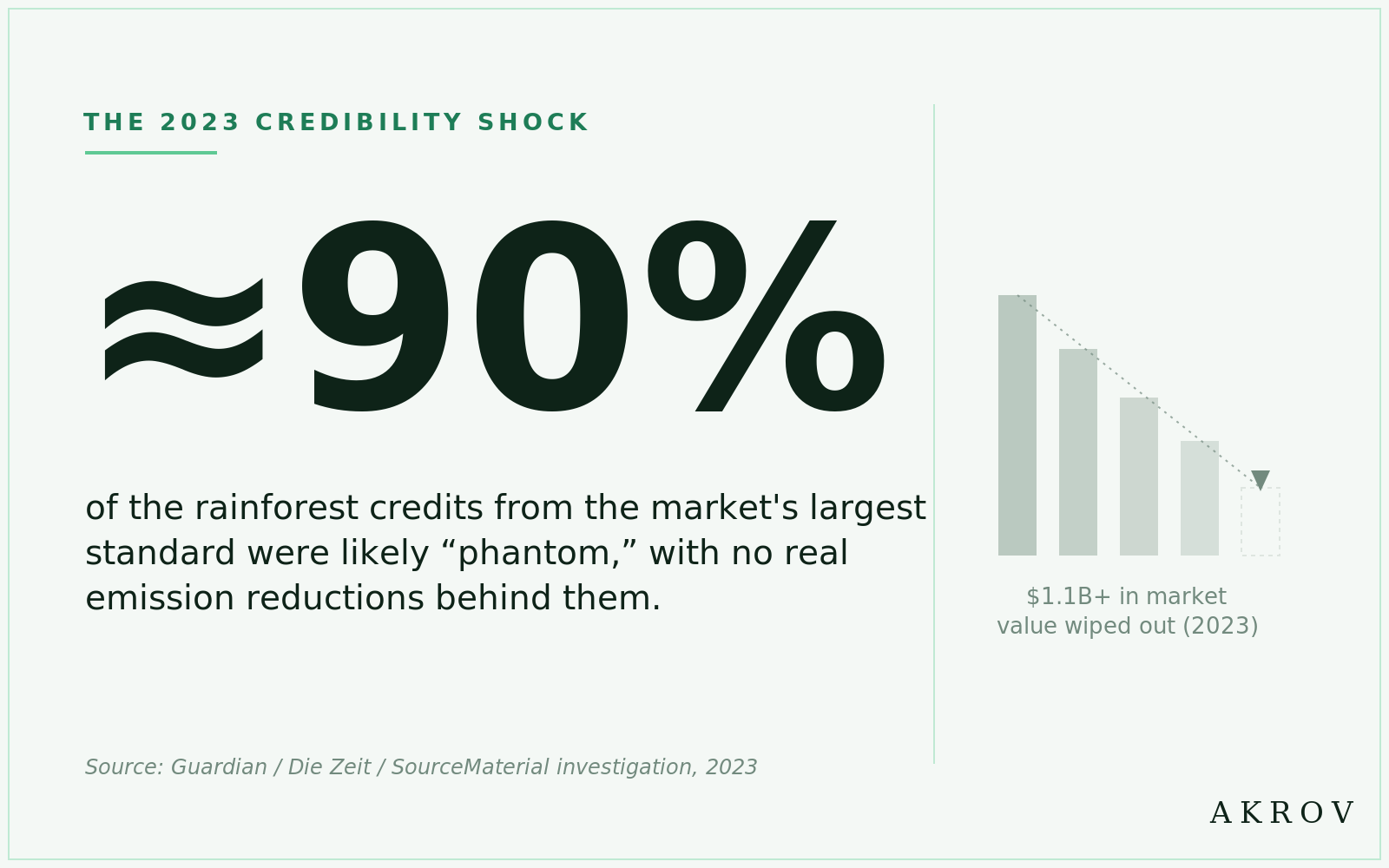
In 2023, an investigation concluded roughly 90 percent of rainforest offsets from the market’s largest standard were likely phantom credits. Trust is now returning — not because the market decided to believe again, but because the evidence is getting harder to fake and easier to check.

Two years ago, the voluntary carbon market was in the middle of a credibility crisis. In early 2023, a nine-month investigation by the Guardian, Die Zeit, and the nonprofit SourceMaterial concluded that roughly 90 percent of the rainforest offset credits approved by Verra, the market’s largest standard, were likely “phantom credits” that represented no real emission reductions. The reaction was swift. More than a billion dollars in market value evaporated, forest (REDD+) credits lost more than 60 percent of their value in a single year, and buyers from Shell to Gucci found themselves defending purchases they had made in good faith.
It would be easy to read that as the end of the story. It was closer to the start of the repair.
What actually went wrong
The scandals were real, but the deeper issue was structural. A carbon credit is a claim about a counterfactual: how much carbon a piece of land holds, and how much it would have lost if the project had never existed. For years, those claims rested on thin foundations. Baselines were often self-reported by the same developers who profited from higher numbers. Monitoring was episodic and sample-based, a field visit here, a satellite snapshot there, then extrapolated across enormous areas. Ratings, where they existed at all, worked like a property appraisal, with an expert forming an opinion from limited data. When the incentive rewards issuing more credits and the evidence is hard to check, over-crediting is not a surprise. It is the predictable outcome.
And it was never only about forests. In 2025, reporting exposed “phantom” rice-cultivation projects issuing methane credits for reductions that had not actually happened. Different sector, same root cause. This was a measurement problem, not a single bad apple.
Why trust is coming back
Here is the part that gets far less attention. Over the same period, the market has been quietly rebuilding its foundations, and the results are now showing up in prices and in policy.
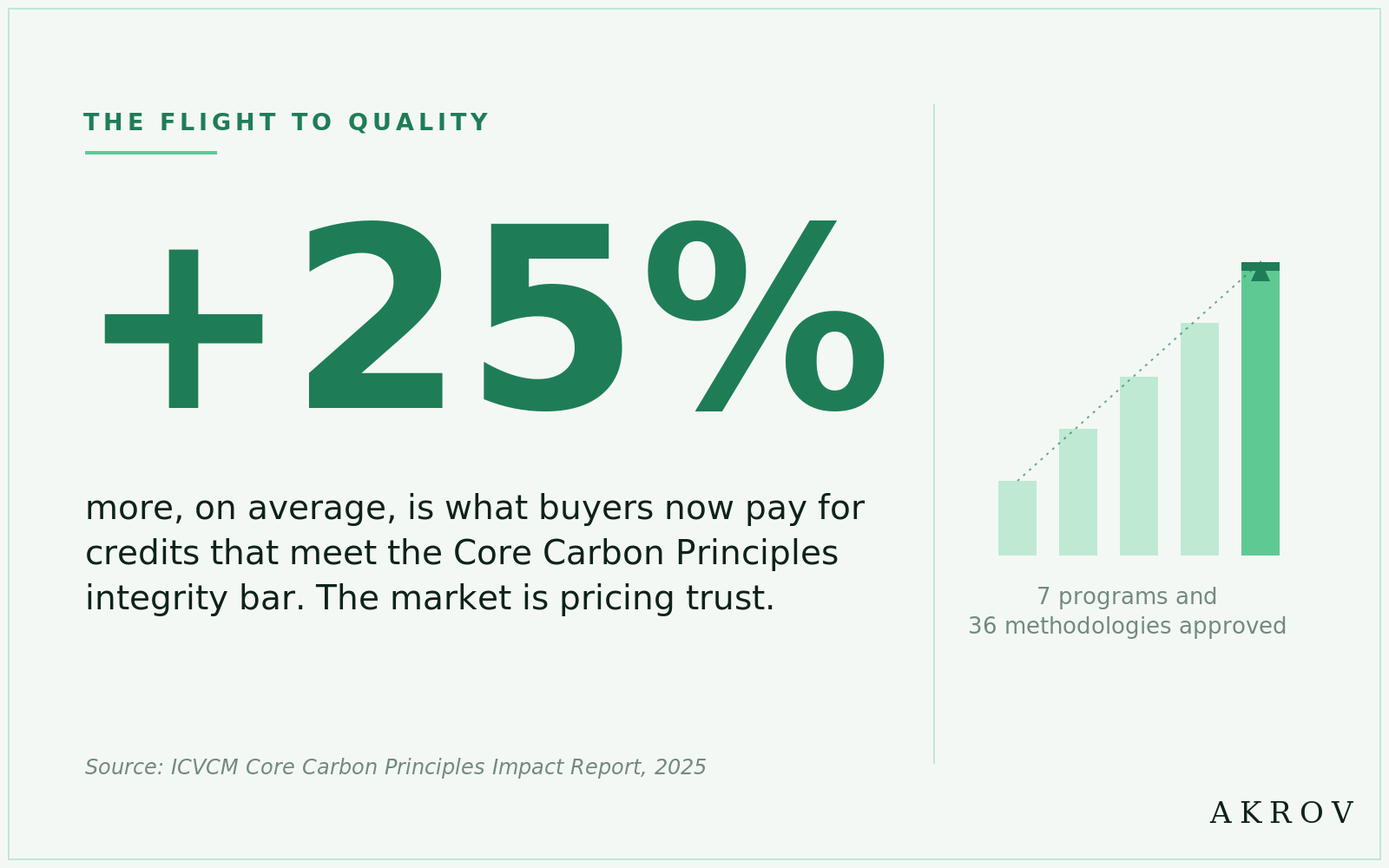
Integrity standards now exist, and buyers are paying for them. The Integrity Council for the Voluntary Carbon Market introduced the Core Carbon Principles, an independent benchmark for what a credible credit has to demonstrate. By late 2025 the Council had assessed seven crediting programs and approved dozens of methodologies against that bar. Credits carrying its label now command a price premium of roughly 25 percent, and demand is concentrating there. That premium matters more than any press release, because it means the market is finally pricing integrity instead of ignoring it.
Governments have stepped in with oversight. At COP29 in late 2024, negotiators finalized the rules for Article 6 of the Paris Agreement after years of deadlock. For the first time, internationally traded credits sit under a United Nations supervisory body, with host-country approval and real safeguards against double-counting. That does not make every credit perfect, but it replaces a purely private, self-governed market with one that has sovereign accountability behind it.
Measurement is replacing opinion. The most important shift is also the least glamorous. Digital monitoring, reporting, and verification, often shortened to digital MRV, is moving the market away from occasional manual checks toward continuous, time-stamped evidence drawn from satellites, radar, and geospatial data. Instead of one convenient estimate, a project can now produce an auditable record that a verifier, a buyer, and a regulator all read the same way. The 2025 criteria for high-quality carbon removal make the logic explicit: integrity means every claimed tonne is real, transparency means everyone sees the same data, and durability means the outcome is tracked for decades.
The through-line
Put those three together and a pattern appears. Trust is not returning because the market simply decided to believe again. It is returning because the evidence behind a credit is getting harder to fake and easier to check. Standards define what must be proven. Government oversight raises the cost of cutting corners. Better measurement makes the proof possible in the first place.
This is the same transition other high-stakes industries made long ago. Insurance moved from an underwriter’s gut feel to actuarial tables. Finance moved from a handshake to audited statements. In every case, trust followed verification, not the other way around. The carbon market is now making the same move, later than it should have, but decisively.
What it means
For anyone building in this space, the implication is clear. The credits that hold their value will be the ones that survive scrutiny: real measurement from multiple independent sources, an honest confidence range instead of a single flattering number, and a provenance trail a verifier can follow from raw data to final claim. The era of taking the number on faith is ending, and that is not bad news for the carbon market. It may be the best thing that has happened to it.
The demand for genuine climate action never went away. What is changing is that the market is finally building the infrastructure to prove the action is real. Trust broke because the numbers could not be checked. It is coming back because, increasingly, they can.
Sources
- 2023 Guardian / Die Zeit / SourceMaterial investigation; ~90% of Verra rainforest credits likely worthless; Shell, Gucci, Salesforce, easyJet as buyers: The Guardian
- >$1.1B in value lost; REDD+ credits down 62% year-over-year; 2023 market contraction: Ecosystem Marketplace / Forest Trends
- Kariba over-issuance (Bloomberg reporting, confirmed by Verra review): Nature Communications, over-crediting review
- “Phantom” rice-cultivation methane projects (2025): Dialogue Earth
- ICVCM Core Carbon Principles: 7 programs, 36 methodologies, ~25% CCP price premium (2025 Impact Report): ICVCM CCP Impact Report 2025
- COP29 finalizes Article 6.2 / 6.4; UN supervisory body; host-country approval; anti-double-counting: C2ES
- Digital MRV role; 2025 high-quality CDR criteria (integrity, transparency, durability): Digital MRV explainer