
Articles·Analysis··6 min read
The Carbon Market Looks Crowded. It’s Really Four Different Businesses.
Ratings agencies, MRV platforms, marketplaces, exchanges — they can all appear in the life of the same tonne, and they do not do the same job. A map of who does what, and where each product stops.

Label every company touching a carbon credit a “competitor,” and the market looks impossibly crowded. Anew Climate develops projects. Charm Industrial produces bio-oil. Patch sells credits. Xpansiv settles trades. Rubicon Carbon manages portfolios. Sylvera rates projects. All of these entities can appear in the lifecycle of a single carbon tonne, yet they perform fundamentally different jobs.
This confusion is expensive. Buyers compare a ratings agency to a marketplace as if they were functional substitutes. Journalists write about “the carbon industry” as if a registry and a direct-air-capture plant shared a common business model. When a credit fails, accountability dissolves into the crowd because no one agreed upfront on who owned which part of the claim.
The most useful question to ask of any carbon company isn’t what it promises; it is where its product stops. Ask that question across leading U.S. and European players, and the market resolves into four distinct operational layers:
- Create: Companies that generate the physical climate outcome.
- Measure: Companies that measure, judge, or audit it.
- Distribute: Companies that aggregate and distribute the resulting credits.
- Trade & Manage: Companies that trade, settle, or manage credits within portfolios.
Each layer carries a unique operational role, primary risk factor, and specific mode of failure.
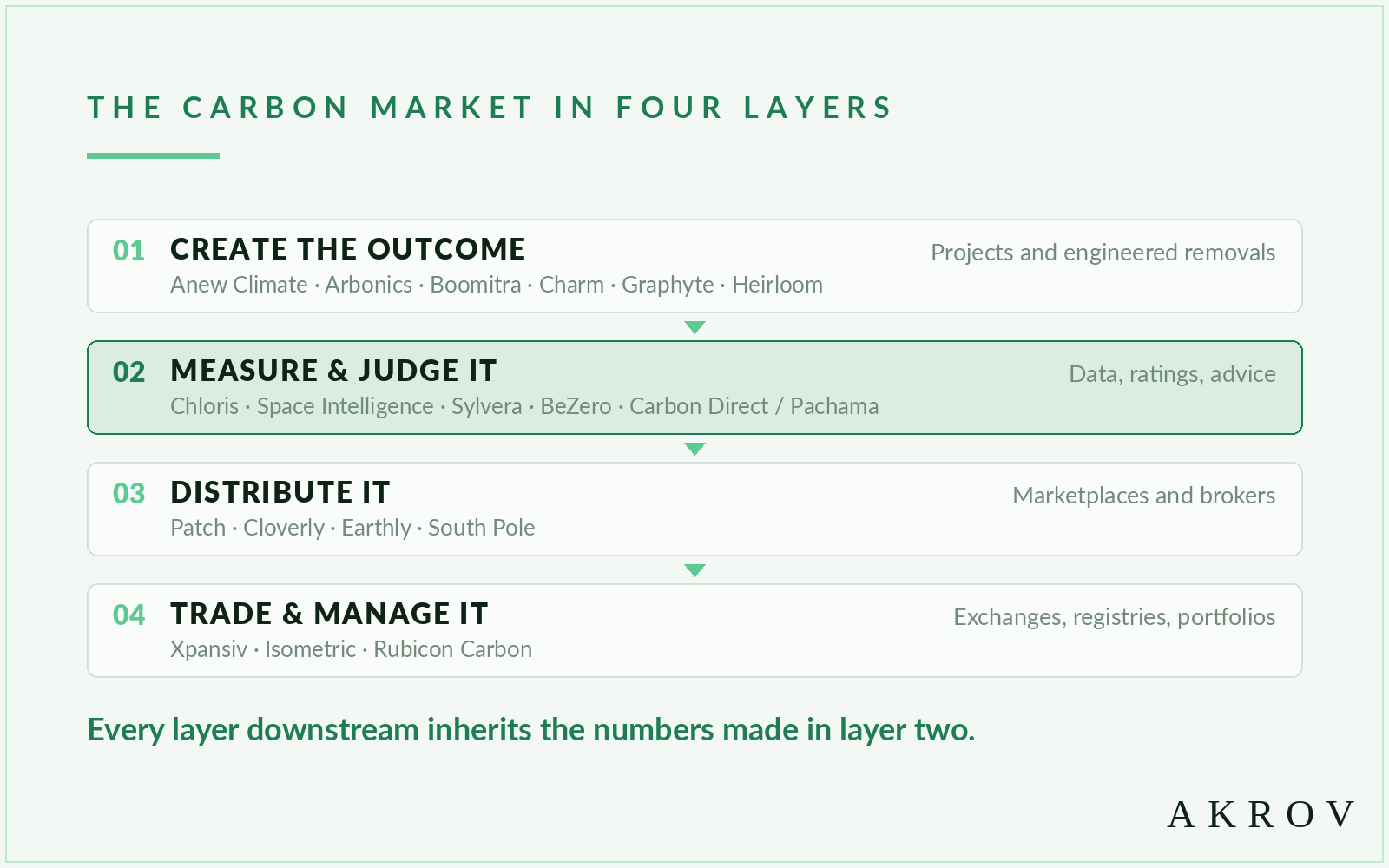
Layer 1: Creating the Climate Outcome
This layer puts carbon into the ground, protects existing carbon sinks, or pulls carbon directly from the air. Its central operational risk is delivery.
Nature-Based Project Developers
- Anew Climate: Develops and markets credits across forestry, agriculture, landfill gas, and carbon capture and storage (CCS), managing over 200 projects with a focus on regulatory origination.
- AgriCapture: Focuses on regenerative agriculture and grassland projects, using field-level data and internal MRV (Measurement, Reporting, and Verification) across more than 150,000 U.S. acres.
- Arbonics: Aggregates European landowners for afforestation and forest management, using satellite data alongside ground truth.
- Boomitra: Executes soil-carbon projects across the Global South, linking satellite imagery with an archive of over one million lab-analyzed soil samples to ground remote sensing data.
- Market Dynamics: Position within this layer is fluid. NCX, for example, built a large forest-landowner network around a one-year carbon program before pivoting to help landowners navigate broader natural-capital markets.
Engineered Carbon Removal
- Charm Industrial: Converts waste biomass into bio-oil for permanent subterranean storage.
- Graphyte: Dries and encapsulates biomass into monitored, underground blocks.
- Heirloom: Operates a limestone-based direct air capture (DAC) process dependent on renewable energy access and permanent geologic sinks.
Grouping engineered removal suppliers with forestry measurement firms is a category error. Engineered removal deals with physical, auditable constraints: mass balance, lifecycle accounting, logistics, and storage integrity. Estimating carbon in a dynamic, living forest ecosystem from orbit presents a completely different mathematical and ecological challenge.
While engineered tonnes offer high durability, nature-based tonnes offer immediate scale, lower costs, and co-benefits. A buyer’s portfolio may require both, but a unified measurement system cannot treat them as identical tasks.
Layer 2: Measuring and Judging the Outcome
Trust in the carbon market is manufactured in the second layer. However, three distinct product types within this layer are regularly conflated: data, opinion, and advice.
| Category | Primary Function | Core Question Answered | Representative Companies |
|---|---|---|---|
| Measurement Data | Raw observation, remote sensing, and structural mapping. | What physical asset is present? |
|
| Ratings | Risk assessment, project ranking, and comparative analysis. | Which projects carry less structural risk? |
|
| Evidence-Based Advice | Strategic procurement, scientific integration, and digital MRV. | What specific action should a buyer take? |
|
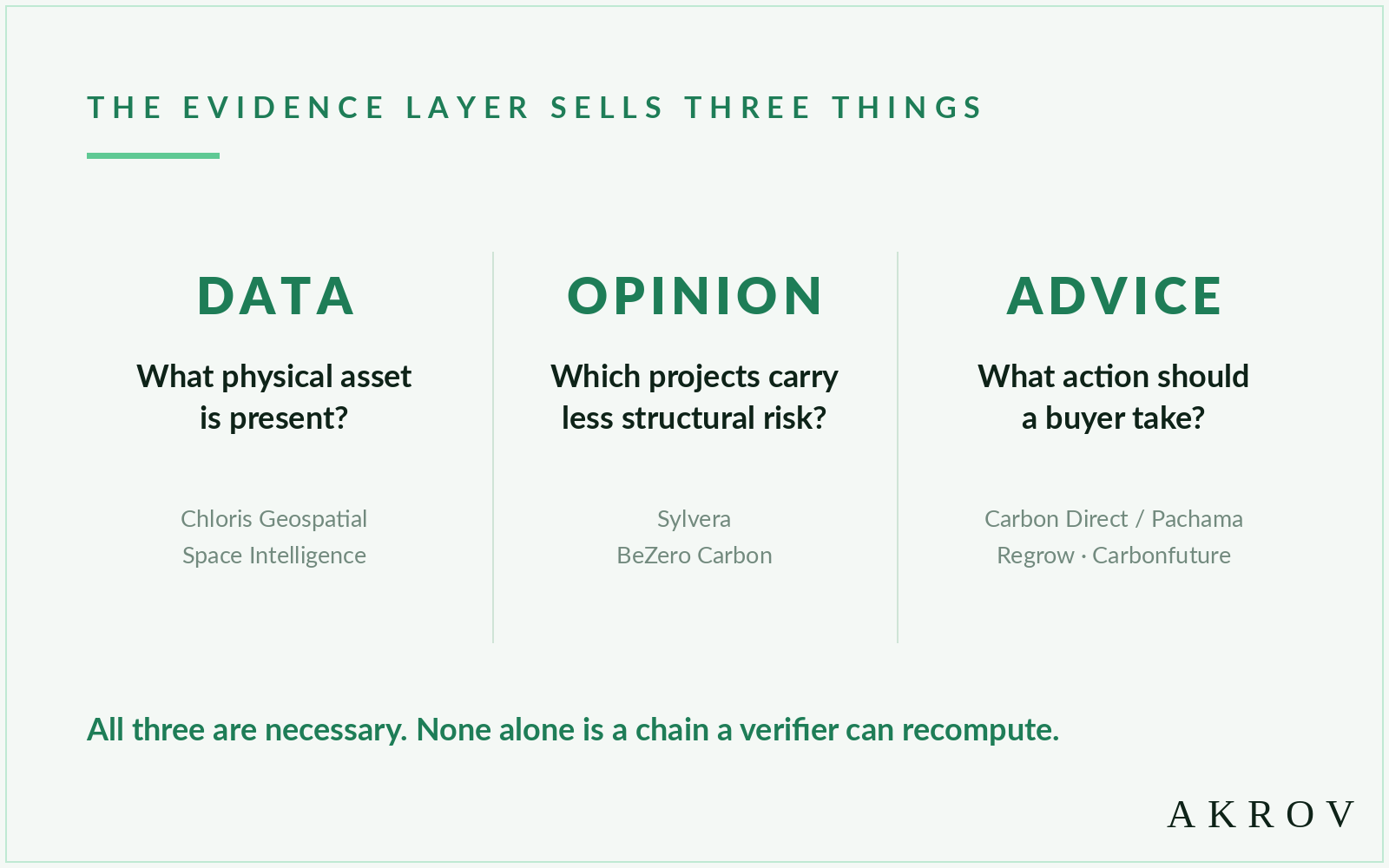
It is critical to understand the legal definition of a rating: Sylvera’s own terms, for instance, define its ratings as ordinal opinions, not deterministic predictions of carbon storage. A rating ranks relative risk; it does not provide an auditor with a fully reproducible physical measurement with an absolute confidence range.
While data, ratings, and advice are all necessary, none of them individually forms a complete, independently verifiable chain from raw ground observation to a final carbon claim.
Layer 3: Distributing Credits
The third layer bridges project supply with corporate demand:
- Patch: Aggregates hundreds of carbon projects, standardizes project metadata, handles due diligence, and streamlines spot purchases or multi-year off-take agreements under unified legal contracts.
- Cloverly: Operates backend API infrastructure, digital storefronts, and inventory software for credit retirements while integrating third-party ratings.
- Earthly & South Pole: Act as brokers and specialized advisory firms, curating credit portfolios for corporate buyers.
The hard boundary of this layer is physical truth. Transaction APIs, standardized metadata, and diligence checklists streamline market mechanics, but they cannot independently prove that a physical tonne of carbon was removed or avoided. Every distribution platform relies entirely on evidence generated upstream in Layer 2.
Layer 4: Trading, Registries, and Portfolio Management
The final layer provides financial infrastructure, liquidity, and asset structuring:
- Xpansiv: Operates the CBL spot exchange (reporting over 300 million tonnes traded since 2020) and connects portfolio infrastructure across more than 15 carbon registries. It solves for price discovery and liquidity. However, standardization makes heterogeneous credits tradable, not scientifically identical.
- Rubicon Carbon: Assembles actively managed, diversified credit portfolios designed to insulate buyers from single-project risk. While diversification reduces isolated project risk, it cannot eliminate systemic or correlated methodology errors across an entire asset class.
- Isometric: Functions as a modern carbon registry by publishing underlying project data, hosting APIs for third-party measurement providers, and deploying tooling that allows auditors to re-execute data calculations directly from raw input files.
The Through-Line of Market Failure
Track any carbon credit from its origin to its final retirement, and note where its underlying numerical claim was generated: Layer 2.
While project developers collect initial field data, the calculated tonne count, base counterfactuals, and uncertainty ranges are established in the measurement and judgment layer. Every downstream layer inherits this fundamental data.
Flawed numerical assumptions in Layer 2 propagate downstream.
If the core measurement is wrong, the systemic failure cascades forward:
- The marketplace distributes an invalid asset.
- The exchange settles an inaccurate credit.
- The portfolio manager diversifies across a correlated mistake.
The market crisis of 2023 was precisely this pattern playing out at global scale.
The primary constraint on the growth of the carbon market is not origination capacity, transactional software, or exchange liquidity—all of those exist at scale. The true bottleneck is hostile-audit-resistant evidence.
Regulatory shifts are accelerating this requirement. European compliance structures admit only pathways with explicitly defined monitoring and liability protocols, while updated consumer protection rules prohibit broad environmental claims backed by vague offset data.
The Next Generation of Carbon Markets
Moving forward, the market will require:
- Explicit Uncertainty Ranges: Numerical measurements bounded by clear statistical confidence intervals, rather than isolated point estimates or simple letter grades.
- Re-computable Provenance: Open, auditable data trails that allow independent third parties to rerun calculations directly from raw inputs.
- Integrated Counterfactuals: Additionality, baseline assumptions, and leakage parameters hardcoded into the data chain alongside physical estimates.
- Data Discipline: The operational willingness to publish no numerical credit at all when underlying empirical evidence is insufficient.
Key Takeaways
- For Carbon Buyers: Ask two direct questions of any vendor: Which layer do you actually operate in? Where does your liability stop? A rating is not a physical measurement; a portfolio is not proof of impact; a marketplace is not an independent auditor. A credit is only as valid as the measurement layer underneath it.
- For Builders and Founders: The primary opportunity is not building another isolated marketplace, generic monitoring sensor, or simple portfolio wrapper. It is fixing the underlying data chain: linking measurement, statistical uncertainty, counterfactual assumptions, and provenance into a single record that regulators, buyers, and auditors can verify identically.
The market has constructed the individual pieces of this system; it is now waiting for the underlying evidence infrastructure to hold them together.