
Articles·Analysis··4 min read
Mangrove Credits Are the Scarcest Thing in the Carbon Market
Blue carbon prices nearly quadrupled in a year. Buyers did not suddenly fall in love with mangroves. Almost nobody can produce a credit that survives scrutiny, and the price says so.
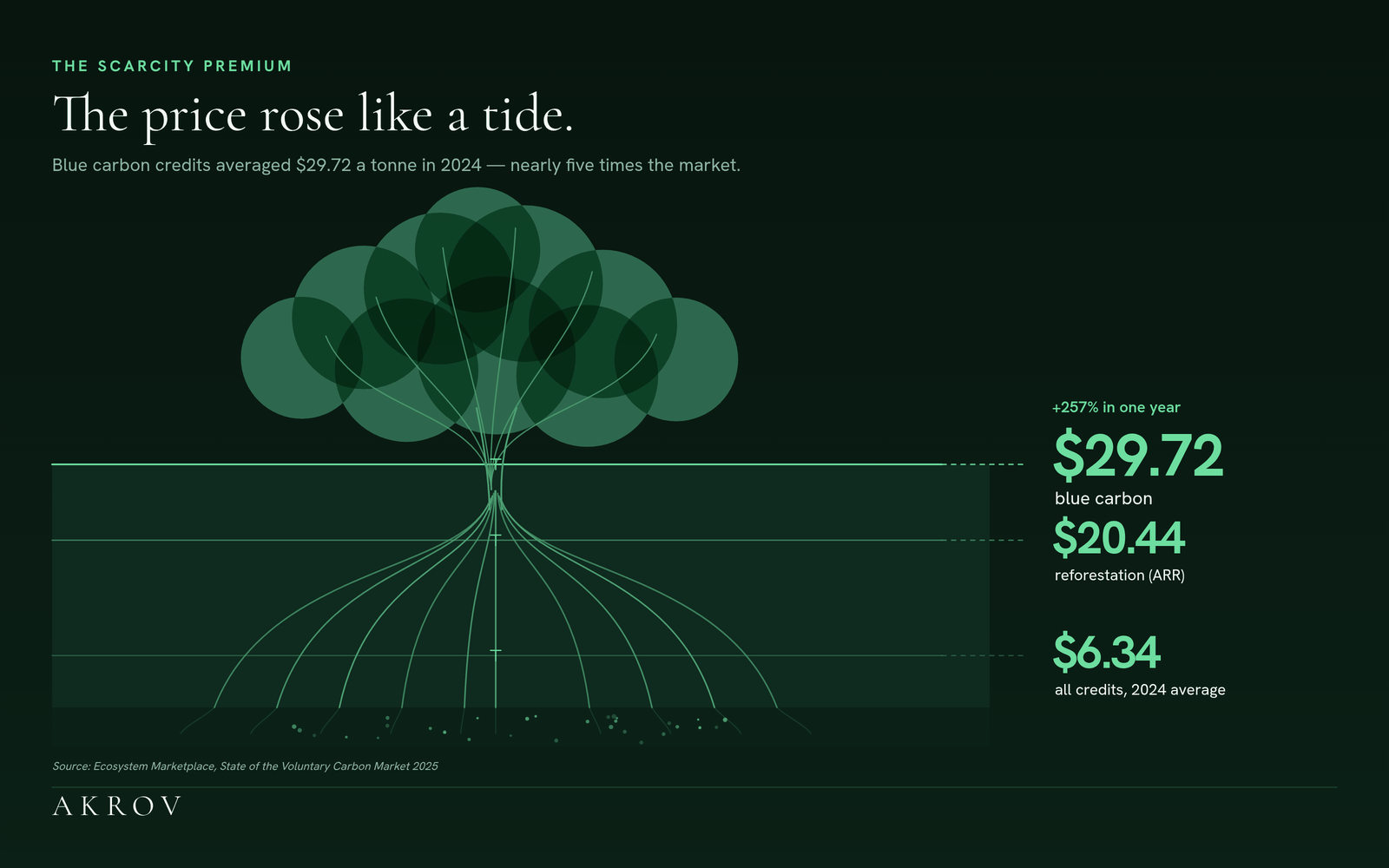
In 2024 the average voluntary carbon credit changed hands at $6.34 a tonne. The average blue carbon credit changed hands at $29.72, up 257% on the year before and nearly five times the market. In August 2025, S&P Global Platts assessed the benchmark mangrove credit, from the Delta Blue Carbon project in Pakistan’s Indus Delta, at a record $29.30, with a trade printed at $30.50. Traders told Platts that demand for nature-based credits had improved “significantly.” One added that available supply “seems a little tight.”
That is a polite way of saying there is almost none.
The demand is real
Buyers want removals, and mangroves are the densest removal there is. Removal credits traded at a 381% premium over reductions in 2024, and Ecosystem Marketplace groups mangrove restoration with reforestation and agroforestry as the largest category of removal credit available today. A mangrove stores on average 1,023 tonnes of carbon per hectare, among the highest of any forest in the tropics. One credit carries a removal label, a biodiversity story and a coastal-protection story at once.
The money is lining up behind them. The Mangrove Breakthrough targets $4 billion to protect and restore 15 million hectares by 2030; by the end of 2025, eleven endorsing governments had written mangroves into their national climate pledges. Buyers of blue carbon credits are 42% American and 40% European, the two markets where claims rules are tightening fastest.
The supply is not
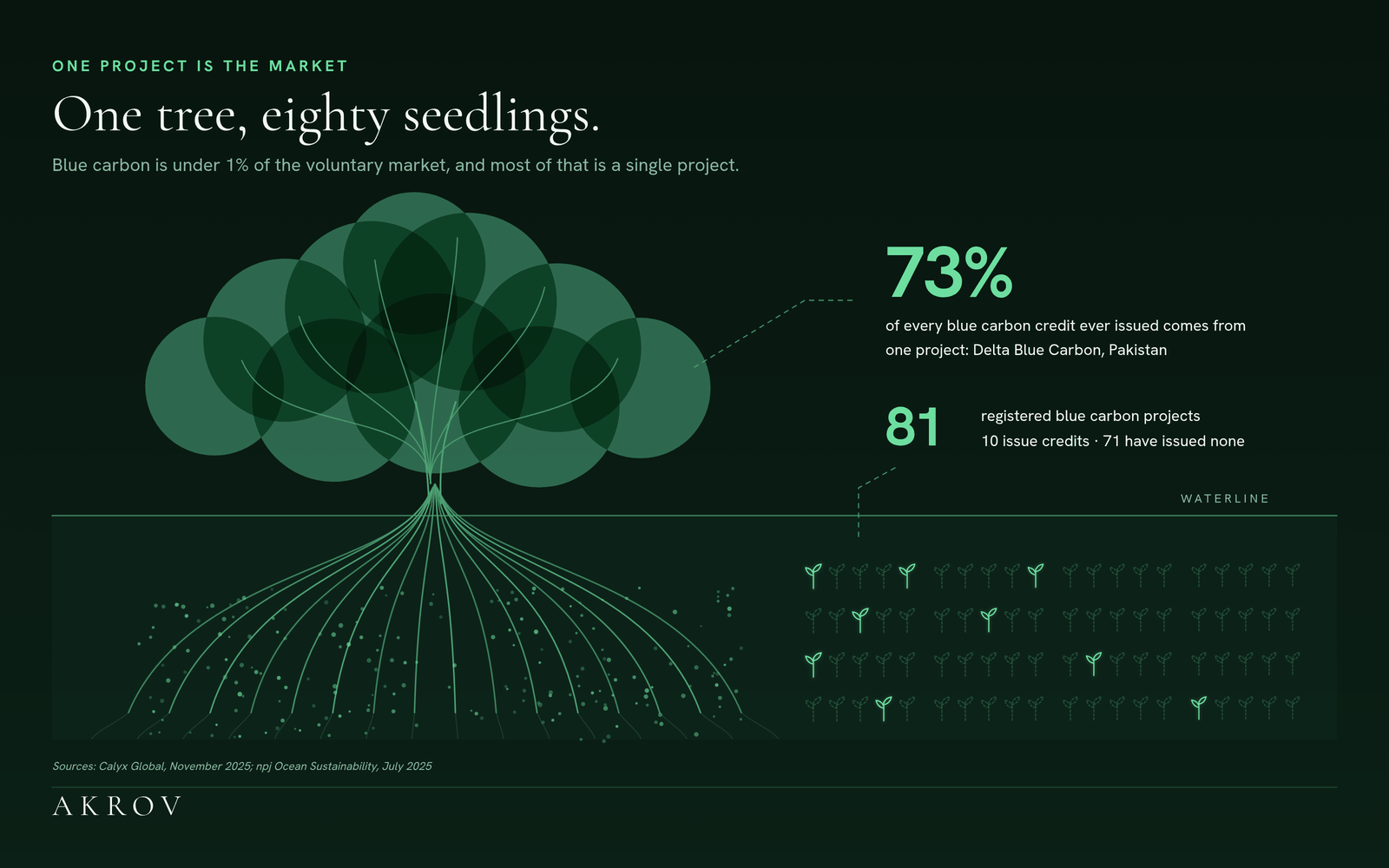
Blue carbon is less than 1% of the voluntary market. Fewer than 7 million blue carbon credits had ever been issued by March 2025, against roughly 180 million tonnes the whole market retires in a single year. Of the 81 blue carbon projects on the registries in October 2025, ten were issuing credits. One of them, Delta Blue Carbon, accounts for 73% of every blue carbon credit ever issued. And in 2024, transacted volume fell, from 0.4 million tonnes to 0.2 million. Price up 257%. Volume down by half. The premium is a scarcity signal, not a quality signal.
Why supply is stuck in the mud
The carbon is where a satellite photo cannot see it. In the study that made mangroves famous, organic-rich soils half a metre to more than three metres deep held 49–98% of the carbon. Crediting that stock means coring it, modelling how tides and sediment move it, and defending a baseline for what would have happened without the project. Calyx Global’s assessment is blunt: measuring carbon in muddy, underwater soil is technically complex and expensive, and monitoring is far harder than for a forest on dry land.
The rulebook is only now catching up. Gold Standard published a mangrove methodology built around remote-sensing monitoring in August 2024. On 11 May 2026, the Integrity Council approved Isometric’s Mangrove Restoration Protocol, the first blue carbon methodology eligible for the Core Carbon Principles label. It arrives with three signed projects and a potential 2 million removal credits by 2030. That is what “first CCP-eligible blue carbon” amounts to. Against a $4 billion ambition and 818,000 hectares the Global Mangrove Alliance rates as restorable, it is a rounding error.
The honest caveat: this is a thin market. The entire 2024 blue carbon trade was worth $5.2 million, and a single large buyer can move the price. One trader told Platts that “people won’t buy DBC at $30+.” A premium built on a handful of projects can deflate as fast as it inflated.
What it means
For buyers: you are paying for scarcity. Before paying $30 for a mangrove tonne, ask how the soil carbon was measured, to what depth, with what uncertainty, and whether the methodology carries or is seeking a CCP label. The premium over a $20 reforestation credit should buy better evidence, not a better story.
For project developers: the constraint on this market is not demand and it is not hectares. It is the ability to produce a number for belowground carbon that a verifier, a rating agency and a buyer’s lawyer will all accept. The project that can show its soil carbon, with an uncertainty range, sells at $30. The project that cannot does not get to market at all.
This is the measurement Akrov exists to make: the tonne in the mud, with an uncertainty a buyer can hold you to.
Sources
- Ecosystem Marketplace, State of the Voluntary Carbon Market 2025 (blue carbon $8.33 to $29.72 per tonne, 0.4 to 0.2 Mt, $5.2M traded; market average $6.34; ARR $20.44; removal premium 381%): Ecosystem Marketplace
- S&P Global Platts, “Platts Blue Carbon credit price at record high amid strong demand, limited supply for DBC-1,” 28 August 2025: S&P Global
- “The rise and flows of blue carbon credits,” npj Ocean Sustainability, 10 July 2025 (6.96 million credits issued by 15 March 2025; 81 active projects; buyers 42% US, 40% Europe; mangroves 99% of claimed reductions): Nature Portfolio
- Calyx Global, “Blue Carbon: What the rising tide of coastal conservation means for the voluntary carbon market,” 4 November 2025 (81 projects, 10 issuing; Delta Blue Carbon-1 at 73% of issued credits; under 1% of the VCM): Calyx Global
- Donato et al., “Mangroves among the most carbon-rich forests in the tropics,” Nature Geoscience, 2011 (1,023 Mg C per hectare; soils 0.5 to more than 3 m deep hold 49–98% of carbon): Nature Geoscience
- Integrity Council for the Voluntary Carbon Market, assessment decisions of 11 May 2026 (Isometric Mangrove Restoration Protocol v1.0 CCP-approved; three signed projects; potential 2 million removal credits by 2030): ICVCM
- Isometric, “ICVCM approves Isometric’s Mangrove Restoration Protocol” (first blue carbon protocol eligible for the CCP label): Isometric
- Gold Standard, “New Mangrove Methodology Featuring Remote-Sensing Expands Nature-based Solutions,” 22 August 2024: Gold Standard
- Mangrove Breakthrough, 2025 Impact Report, 30 January 2026 ($4 billion for 15 million hectares by 2030; eleven endorsing governments with mangroves in their NDCs): Mangrove Breakthrough
- Global Mangrove Alliance, State of the World’s Mangroves 2024 (15 million hectares; 818,300 hectares restorable): Global Mangrove Alliance