
Articles·Analysis··9 min read
Who Actually Mints a Carbon Credit?
A measurement isn’t a credit. Somewhere downstream of every estimate, an institution creates a serialized unit and assigns it to an account — and that job is being rewritten faster than any other part of the market.

Almost every argument about carbon markets is an argument about numbers — how much carbon is in that forest, whether it would have been cut, how long the storage lasts. Those arguments matter. But a number is not a tradable asset. Somewhere downstream of every estimate, an institution opens a database, creates a serialized unit, and assigns it to an account. That is the moment a measurement becomes a credit.
Very few people can name who does that, or on what authority. The market talks endlessly about ratings agencies, marketplaces and removal suppliers, and almost never about the entities holding the pen.
That gap is about to become expensive, because minting is the part of the market changing fastest. In the last eighteen months the UN issued its first credits under the Paris Agreement, the EU adopted its first certification methodologies without yet recognising a single certifier, and two registries began creating credits on monthly cycles from automated data feeds instead of annual audits.
The question worth asking is not who sells credits. It is who is allowed to create one, and what they actually check before they do.
What minting actually is
The chain from field to unit is longer than most buyers assume, and almost none of it is measurement.
A developer designs a project and registers it with a crediting programme. An accredited third party — a Validation and Verification Body, or VVB — validates the design against a published methodology. The project operates through a defined monitoring period. The developer prepares a monitoring report. A VVB verifies that report. The developer submits an issuance request. The registry reviews it and creates serialized units in the developer’s account. Those units move to a buyer, and are eventually retired — permanently cancelled against a claim.
The registry acts at the seventh step. Everything it relies on happened before it.
Note where the registry sits in that sequence. It is at the end. Its job is not to know whether the tonne is real; it is to ensure that exactly one unit exists for a claim somebody else verified against rules the registry published. Registries are, structurally, ledger operators with a rulebook — not measurement institutions.
The serial number is where that structure becomes visible. Climate Action Reserve’s schema encodes the originating registry, unit type, host country, project ID, project type, developer, jurisdiction, vintage year — the year the reduction or removal actually occurred — a batch number, and the serial block identifying which specific tonnes sit inside that batch. Every registry uses a variant of this. It is a remarkably informative string, and it says nothing at all about how confident anyone was in the underlying number.
A biomass estimate with a coverage interval enters the process. An integer count of units leaves it.
Two consequences follow. First, uncertainty does not survive the minting step. Second, the vintage field quietly reveals how slow the process is. RMI’s interviews with developers put the typical time to first issuance at two to three years, longer for nature-based and novel pathways, with MRV consuming an estimated 20–30% of total credit revenue. Credits then sit an average of roughly six years between issuance and retirement.
That is the system the digital-issuance wave is aimed at.
Who holds the pen today
Independent crediting programmes still mint most of the world’s credits. Verra’s VCS is the largest by a wide margin and took about half of reported over-the-counter transaction volume in 2024. It is also the most visibly reformed: after the 2023 REDD+ crisis and its founding CEO’s departure, Verra installed Mandy Rambharos as chief executive in July 2024 and launched VCS Version 5.0 in December 2025, with the previous version valid until January 2027.
Below Verra sit the American Carbon Registry, Gold Standard and Climate Action Reserve — CAR issued its 250-millionth credit in January 2026, and a record 27.6 million in 2025 alone. The newer removal-only registries are much smaller but disproportionately influential on process: Puro.earth passed one million tonnes of verified removal around March 2025, and Isometric has built its entire product around auditability rather than volume. Qatar-based Global Carbon Council issued roughly 4.5 million credits in 2025 against a cumulative 13.1 million, targeting 18 million in 2026.
Compliance mechanisms are now issuing too, and this is the genuinely new development. On 26 February 2026, the Article 6.4 Supervisory Body approved the first-ever issuance under the Paris Agreement Crediting Mechanism — a clean-cooking programme in Myanmar, with the majority of credits authorized for the Republic of Korea’s use and the remainder retained by Myanmar. The Supervisory Body’s chair made the point that should worry anyone holding legacy inventory: by applying updated values and more conservative calculations, the credited reductions came out roughly 40% lower than the older system would have issued for the same activity.
For aviation, ICAO’s Council has approved eight programmes as eligible for CORSIA’s first phase — ACR, ART, Climate Action Reserve, Global Carbon Council, Gold Standard, Isometric, Thailand’s Premium T-VER and Verra’s VCS — with four re-approved so far for 2027–2029.
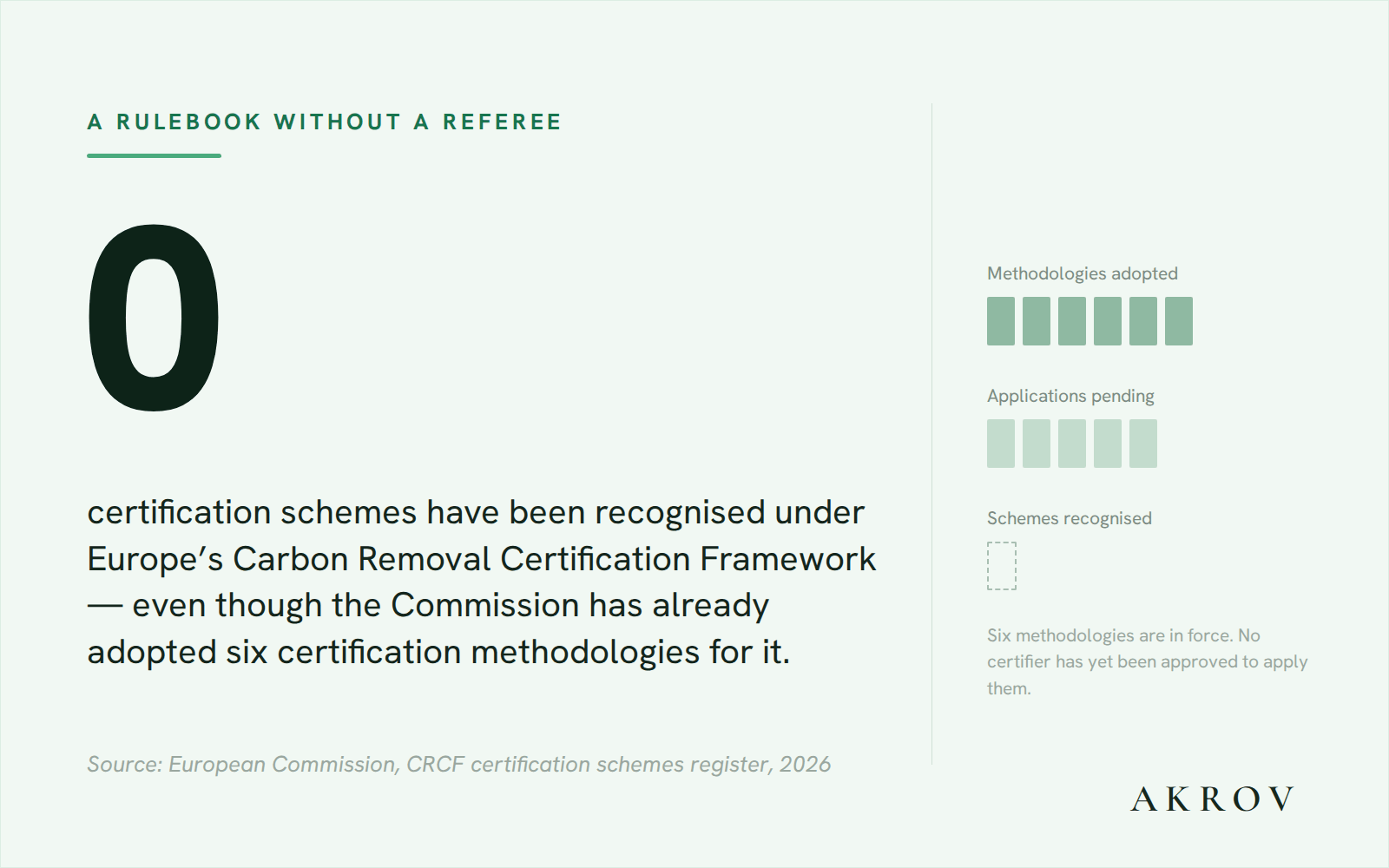
The European Union is the interesting case, because it has built a rulebook and not yet appointed a referee. The Commission adopted its first CRCF certification methodologies in February 2026 (DACCS, BioCCS, biochar) and three carbon-farming methodologies in July 2026 (mineral soils, peatland rewetting, afforestation). But on the Commission’s own certification-schemes register in mid-2026, zero certification schemes had been formally recognised — five applications were in progress, from Isometric, Puro, Rainbow Standard, Oncra and Planet First Registry. Schemes must initially run their own interoperable registries; a unified EU Union Registry is intended to replace them within four years, which policy trackers place around 2028.
And then there are the bodies that set the bar but mint nothing. The ICVCM’s Core Carbon Principles label has become the de facto quality floor without the Integrity Council ever issuing a credit: as of August 2026, thirteen programmes are CCP-eligible, covering an estimated 95% of cumulative voluntary-market issuance. ICROA endorses programmes against a code of practice. CAD Trust operates as a meta-registry, harmonising metadata across connected registries — twelve as of January 2026 — so that the same tonne cannot be counted twice in two ledgers.
None of these three can create a unit. All three can make it much harder to sell one.
The bottleneck is permission, not science
Before getting to the technology, it is worth being precise about what is currently jamming issuance, because it is not measurement quality.
Under the CDM-to-PACM transition, 1,512 project activities requested transfer into the new mechanism. By the 30 June 2026 deadline, only 415 — about 27% — had secured the host-country approval they needed. China withheld approval for 527 projects; India approved none of the 460 that asked. Activities without approval face administrative cancellation from 1 July 2027, putting a very large volume of 2021–2025 vintage credits at risk of simply ceasing to exist as tradable units.
Nothing about that is a scientific failure. It is sovereign authorization — countries deciding whether to let mitigation leave their national accounts. The same logic governs CORSIA-eligible supply, where a host-country letter of authorization sits on top of programme-level eligibility.
Anyone modelling future credit supply from methodology pipelines alone is modelling the wrong constraint.
Minting is becoming a function, not an event
Now the part that changes the shape of the market.
Isometric issued the first credits generated through automated data sharing in November 2025 — 291 verified removal credits to Charm Industrial, with monitoring data flowing from a third-party dMRV platform directly into Isometric’s Certify API rather than through manual submission. Isometric has built a partner network of third-party dMRV providers who can feed Certify directly, and runs monthly issuance cycles with eligibility confirmation in about a week.
Verra followed on 19 February 2026, approving the first credits under its dMRV pilot: the Foumbouni–Mitsamiouli solar farm on Grande Comore in the Comoros, with digital data submitted straight into Verra’s Project Hub and credits issued in monthly or bi-monthly instalments instead of annually. Verra plans to extend the model to CCS and clean cookstoves.
Puro.earth launched Issuance Plus in January 2026 — higher-frequency batch issuance for large industrial suppliers — and runs a dMRV Connect API for third-party data. Gold Standard approved three dMRV pilots across electric cooking, biomass cookstoves and paddy cultivation.
Underneath, the data plumbing is standardising. CAD Trust completed a Data Model 2.0 API in January 2026, targeting full transition of connected registries by mid-year. RMI published an open-source Carbon Crediting Data Framework in July 2025 — 570-plus standardized fields expressed in JSON Schema. Verra and the Hedera Foundation are digitising methodologies into structured workflows, with twenty methodologies targeted in the partnership’s first year.
Tokenization, notably, is not part of this story — or not the part its advocates promised. The 2021–22 wave collapsed: Verra banned tokenizing retired credits in 2022, Flowcarbon never launched, Nori shut down in 2024, Toucan open-sourced its protocol and pivoted away. The institutional second wave is real but early — JPMorgan’s Kinexys has been testing carbon tokenization with registry partners, and Verra’s Hedera work is explicitly about workflow digitisation, not on-chain issuance. As of August 2026 there is no live, exchange-traded, compliance-linked tokenized credit product. The thing that actually accelerated minting was an API, not a chain.
Read the 20% withhold
The most instructive detail in the entire digital-issuance story is a footnote in Verra’s pilot design. Approved proponents may request 80% of credits immediately; Verra withholds 20% as a safeguards measure. To release the remainder, a project must complete a full verification after one year covering additional parameters — safeguards, stakeholder engagement.
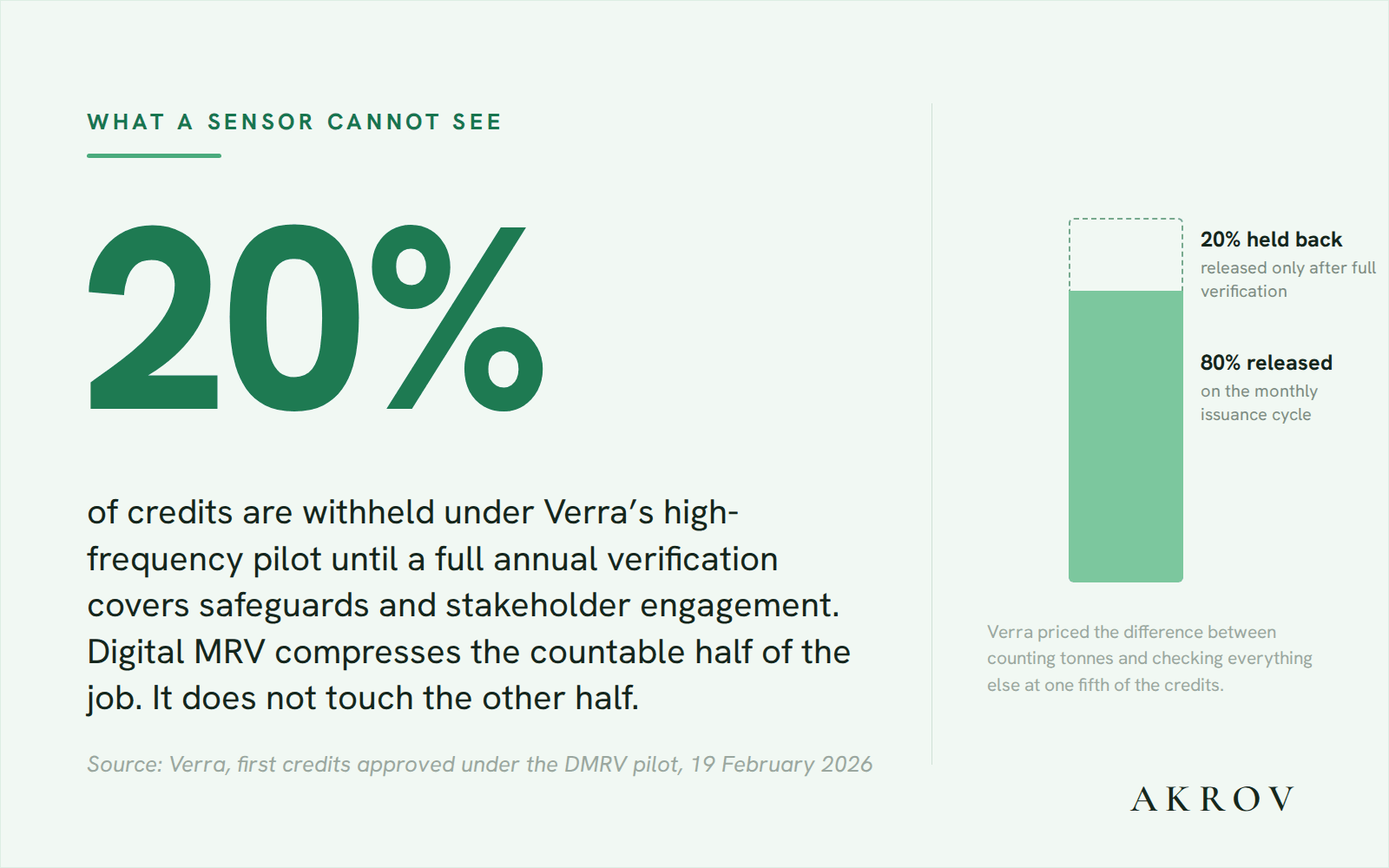
That reserve is an admission, and a healthy one. The annual verification was never only a tonne count. It was also the moment someone checked the things a sensor cannot see: whether communities consented, whether the project harmed anyone, whether the paperwork described the same project as the satellite. Digital MRV compresses the countable half of that job brilliantly. It does not touch the other half. Verra priced the difference at twenty percent and said so publicly.
The second thing worth reading carefully: the speed gains are documented, with named projects and hard dates. The cost gains are not. Every quantified cost-reduction claim available today comes from registries or dMRV vendors describing their own products. No independently audited figure exists for what digital issuance saves per tonne. Faster is proven. Cheaper is asserted.
What this means for evidence
If a credit can be minted monthly from a data feed, the data feed becomes the control point for the entire market. That is the strategic fact.
Under annual verification, a bad number had a year and a human reviewer standing between it and a serial number. Under continuous issuance, it has an API contract. Automation does not make evidence better or worse; it removes the latency that used to function, accidentally, as a safety margin. Whatever quality the input has, the output now inherits at machine speed.
Which puts a sharper edge on four requirements the market has been circling for years:
- Uncertainty has to survive minting. An estimate with a coverage interval that becomes an integer count of units has lost the information the buyer most needs. If issuance is continuous, the interval has to travel with the unit — or be used to discount it.
- Provenance has to be recomputable. Not a PDF describing a calculation, but the inputs, method, version and output preserved so an independent party can rerun it and get the same answer.
- Counterfactuals belong in the same chain as the physical estimate. Additionality, leakage and permanence cannot sit in a separate narrative document when the physical side has gone automated and the narrative side has not.
- Abstention has to be a supported output. A system that can only produce a number will produce one when it shouldn’t. The ability to return a signed refusal — no tonnage, with a recorded reason — is what keeps automated issuance honest at the edges of a model’s competence.
Key takeaways
| If you are | The question that now matters |
|---|---|
| A buyer | Which programme minted the unit, under which methodology version, and what did the verification actually cover? In 2026 those are three different questions with three different answers — and a credit minted under a monthly dMRV pilot has a materially different assurance profile from one minted under a full annual verification, even from the same registry. |
| A developer | The binding constraint on supply is increasingly authorization, not measurement. Host-country approval, programme eligibility and certification-scheme recognition are now on the critical path, and the PACM transition numbers show what happens to projects that treat them as paperwork. |
| Building infrastructure | The registries have made their move: they are becoming APIs. The open position is not another ledger — it is the evidence layer feeding it, where uncertainty, provenance and refusal are first-class outputs rather than annotations. |
A serial number can be minted from a wrong measurement just as easily as a right one. The only thing that has changed is how quickly.
Sources
- Issuance process and programme rules: Verra, VCS Program Details; Verra, VCS Version 5 launch
- Serial-number structure: Climate Action Reserve, Serial Number Guide; issuance milestone: 250-millionth credit, 12 January 2026
- Time to issuance, MRV cost share and issuance-to-retirement interval: RMI, How to Build a Trusted Voluntary Carbon Market; data standardization: RMI, Carbon Crediting Data Framework
- First Article 6.4 issuance, 26 February 2026: UNFCCC. CDM-to-PACM host-country approval backlog: Fastmarkets
- CORSIA eligible programmes: ICAO
- EU CRCF methodologies and certification schemes: European Commission, 3 February 2026; 10 July 2026; certification-schemes register
- Quality gatekeepers: ICVCM assessment status; ICROA endorsed organisations; CAD Trust Data Model 2.0
- Digital issuance: Isometric, automated data sharing; Verra dMRV pilot, 19 February 2026; Puro Issuance Plus; Gold Standard dMRV pilots; Verra & Hedera