
Articles·Analysis··8 min read
Will Washington Ever Make Carbon Offsets Mandatory?
The US federal government spent 2024 building a framework for voluntary carbon markets, and has spent 2025 and 2026 dismantling the authority that framework rested on. The mandate everyone keeps predicting is arriving nonetheless. Just not from Washington.
Ask anyone in the American carbon market the same question: “Will the government eventually make companies offset their emissions?” You’ll hear the same answer: eventually, probably, once the politics settle. It’s the assumption underneath a lot of forward purchases and a lot of pitch decks.
The last eighteen months answered the question. In reverse.
On May 28, 2024, the Treasury Secretary, the Agriculture Secretary, and the Energy Secretary jointly signed a federal policy statement endorsing high-integrity voluntary carbon markets. On February 12, 2026, the EPA finalized the repeal of the 2009 endangerment finding; the legal foundation under nearly every federal greenhouse-gas regulation issued since. The distance between those two documents is the real story of the US voluntary carbon market. Not whether offsetting becomes mandatory at the federal level, but why the enforcement that is arriving comes from everywhere except the federal government.
The market Washington was trying to regulate
Strip out the noise and the US voluntary carbon market in 2026 looks like this: smaller by volume, larger by value, and dramatically better sorted by quality.
Ecosystem Marketplace’s State of the Voluntary Carbon Market report found transaction volumes fell 25% in 2024 while average prices declined only 5.5%. Buyers walked away from cheap credits, not the market. Roughly 182 million tonnes were retired in 2024 across the ten largest standards, a level that has held broadly steady since 2021. Removal credits traded at a 381% premium over reduction credits, up from 245% the year before.
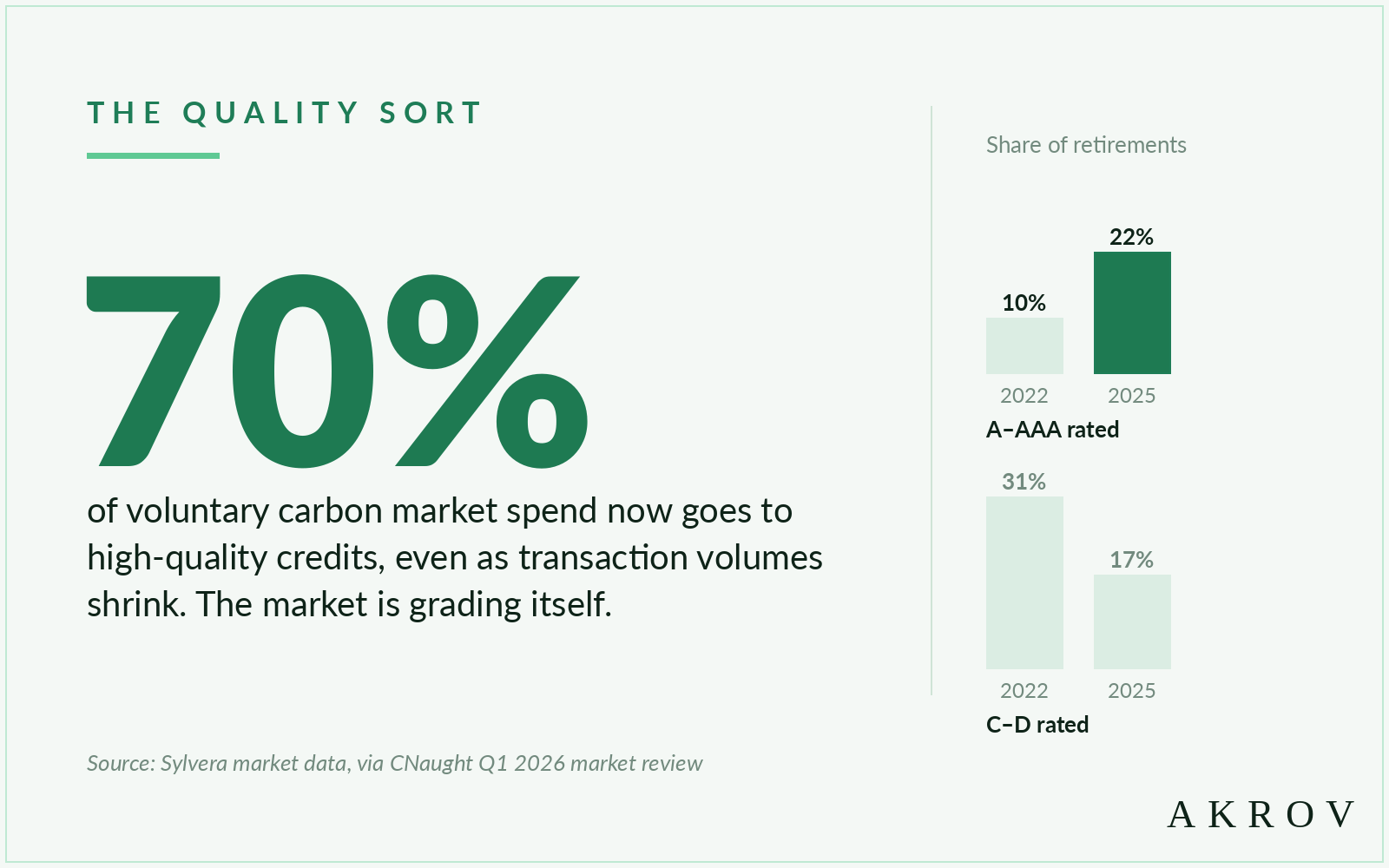
The quality sorting is the trajectory that matters. Credits rated A to AAA doubled their share of retirements between 2022 and 2025, from 10% to 22%, while C- and D-rated credits fell from 31% to 17%. High-quality credits now account for roughly 70% of market spend. Direct offtake agreements for carbon removal reached about $7 billion through November 2025, up from $2.6 billion in 2024. Volume shrank. Money concentrated. The market is not dying. It is grading itself.
The high-water mark: 2024
For one year, the US federal government looked like it was preparing to stand behind this market.
The Joint Policy Statement. Published May 28, 2024, and signed by Janet Yellen, Tom Vilsack, Jennifer Granholm, and the White House’s senior climate and economic advisers, it laid out seven principles for voluntary carbon markets: atmospheric integrity (additionality, quantifiability, verifiability, permanence, robust baselines), social safeguards, value-chain cuts first, annual public disclosure of credit use, claims backed only by high-integrity credits, market-integrity participation, and lower transaction costs. It was the closest thing the US has ever produced to a federal definition of a good carbon credit.
The CFTC’s final guidance. On September 20, 2024, the Commodity Futures Trading Commission approved final guidance for exchanges listing voluntary carbon credit derivative contracts — the product of five years of work, and a signal that the agency saw carbon credits as commodities worth standardizing. Then-Chairman Rostin Behnam called the CFTC “on the front lines of the now global nexus between financial markets and decarbonization efforts.”
Neither document was a mandate. Both were scaffolding a mandate could have been built on.
The reversal: 2025–2026
The dismantling has been fast and specific.
Paris, gone. The withdrawal ordered on January 20, 2025 took effect on January 27, 2026, and the administration has announced its intent to withdraw from the UN Framework Convention on Climate Change entirely.
The CFTC guidance, challenged. On January 30, 2025, Senator John Kennedy introduced a joint resolution to strip the CFTC’s carbon-credit guidance of any effect. The guidance was never a binding regulation, so the practical stakes are limited, but the direction of travel is unambiguous.
The SEC climate rule, rescinded. After abandoning its court defense of the 2024 climate-risk disclosure rule, the SEC formally proposed rescission on May 29, 2026. The rule never required offset reporting directly, but it was the main federal instrument that would have made corporate reliance on credits visible to investors.
The endangerment finding, repealed. On February 12, 2026, the EPA finalized what its administrator called the largest deregulatory action in US history: rescission of the 2009 finding that greenhouse gases endanger public health and welfare. That finding underpinned federal GHG rules for vehicles, power plants, and oil and gas operations. The EPA’s stated position is now that the Clean Air Act’s Section 202(a) does not authorize greenhouse-gas standards at all.
The honest caveat: almost none of this is settled. Environmental groups and states, with California at the spearhead, are suing over the endangerment repeal. IRA rescission efforts have already been partially halted in court, and a future administration could reverse course, as one did before. But reinstating authority takes years of rule making and litigation. Aside from politics, the near-term reading is the same: the federal government is not preparing to mandate offsetting. It is un-writing its own authority to regulate carbon at all.
Why a federal offset mandate was always the long shot
It’s worth being precise about what “federally enforced offsetting” would require, because understanding the requirements helps clear up the reason for lack of its existence.
A compliance obligation needs a statute. The US has tried exactly once at scale: the Waxman-Markey cap-and-trade bill passed the House 219–212 in June 2009 and died in the Senate without a vote. No comparable economy-wide carbon bill has come to the floor since. Regulation without a statute, the Clean Power Plan route, ran into West Virginia v. EPA in 2022 and now, with the endangerment finding repealed, has no foundation left to build on until courts or Congress restore one.
Most projections skip a specific detail: even at peak federal support, offsets were never the instrument. The 2024 Joint Policy Statement, being the friendliest document the US government has ever issued on carbon credits, states plainly that credits should supplement value-chain emissions cuts, not substitute for them. The most pro-VCM administration in US history endorsed credits as a voluntary complement. A mandate to offset was not on the table even then.
Where enforcement is actually arriving
None of which means the era of purely voluntary carbon is continuing. It’s ending, but through three channels that don’t run through Washington.
Aviation, by treaty. CORSIA’s Phase 1 became enforceable in January 2026, with around 130 states participating. Airlines must offset emissions above 85% of their 2019 baseline, with first compliance due by January 2028. IATA estimates demand at 146–236 million credits for the 2024–2026 period, at a compliance cost of roughly $1.7 billion for 2026 alone. This is the first time a large, enforceable obligation has been pointed directly at credits from the voluntary market’s own supply base, and US carriers are inside it regardless of federal climate policy.
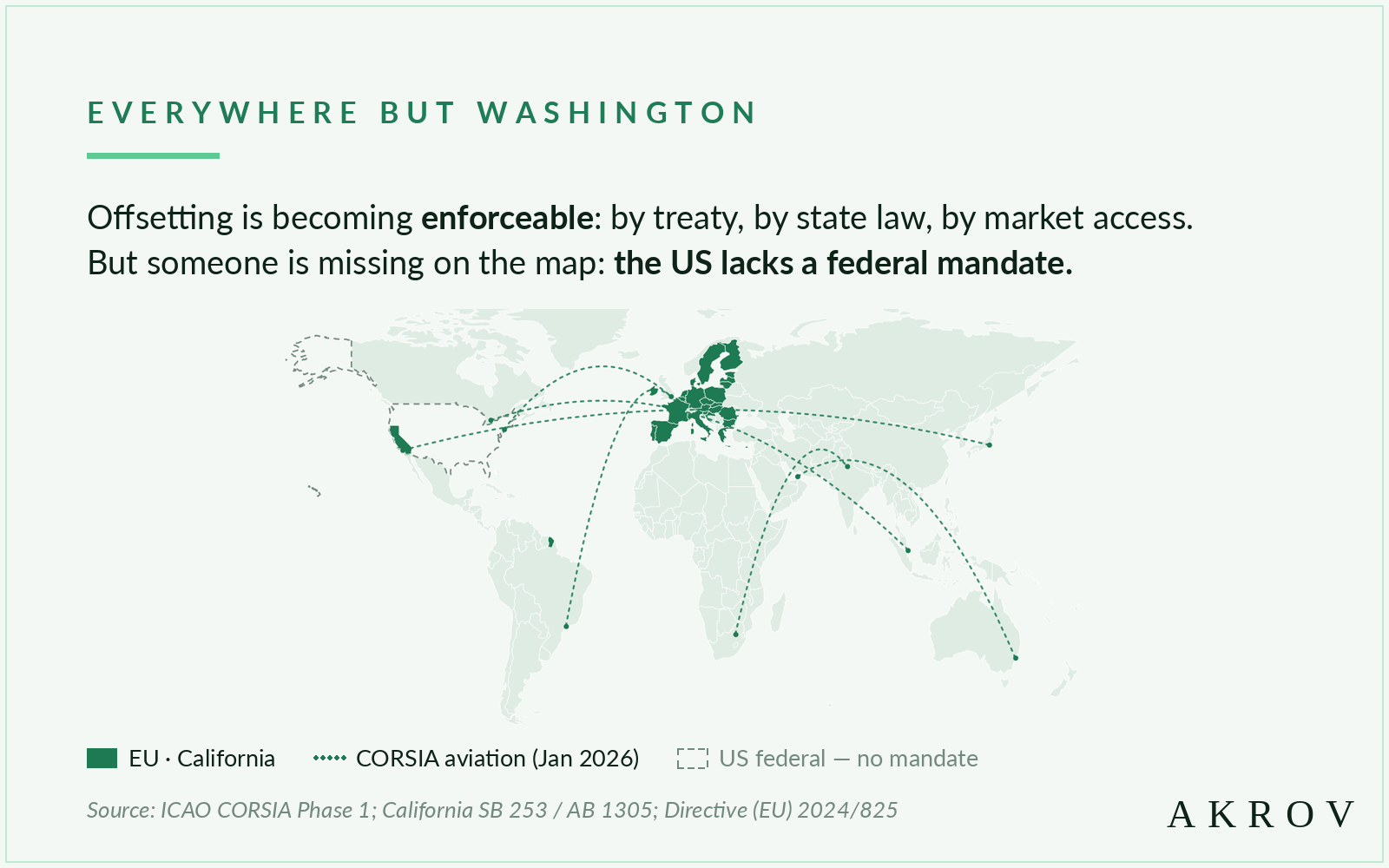
California, by statute. In 2025, California extended its cap-and-trade program. Now called “cap-and-invest”, through 2045. SB 253 requires companies over $1 billion in revenue doing business in the state to report Scope 1 and 2 emissions, with first reports due August 10, 2026. AB 1305 already requires any company operating in California that markets or uses carbon offsets to disclose, publicly, which credits, from which projects, under which protocols. California cannot mandate offsetting nationally. It can, and does, make unverifiable credit claims legally hazardous for most of the Fortune 500.
Europe, by market access. The EU’s Empowering Consumers Directive takes force in September 2026, banning unsubstantiated “climate neutral” claims outright, and the EU is separately building carbon removals into its compliance architecture. Any US company selling into Europe inherits those rules the way it inherited GDPR.
So the real trajectory is not “voluntary today, federally mandated tomorrow.” It is a patchwork hardening: treaty obligations for aviation, state-level disclosure and carbon pricing, foreign claims regimes. Each mechanism converts some slice of the voluntary market into de-facto compliance. Same carbon dioxide. More laws.
What it means
For buyers: stop waiting for a federal mandate to justify the purchase, and stop fearing one. The binding constraint on credits is already here, and it is evidentiary, not political. If you operate in California, AB 1305 obliges you to name your credits in public. If you make claims in Europe from September 2026, they must survive substantiation. The question that decides exposure is not “will offsetting become mandatory?” but “will this specific tonne survive an audit under whichever regime already touches me?” The market has re-priced around this: a 217% premium for recent vintages, quality credits at 70% of spend. The regulators across the world are pricing it in too.
For builders and project developers: the demand signal worth planning around is not a hypothetical US compliance market. The CORSIA volumes, California’s 2045 horizon, and off-take agreements grew from $2.6 billion to $7 billion in a year. All three pay for the same thing: measurement that holds up under someone else’s scrutiny. A credit that clears CORSIA eligibility, an ICVCM label, and an AB 1305 disclosure simultaneously is worth more than three credits that each barely clear one.
The federal question will stay open. Endangerment litigation alone guarantees years of back and forth. But a market that waits on Washington to define quality has misread the last eighteen months twice over. Enforcement didn’t wait. Measurement can’t either.
This is the problem Akrov exists to solve: measurement that holds up under whichever regime touches you.
Sources
- US Treasury, Voluntary Carbon Markets Joint Policy Statement and Principles, May 28, 2024: Treasury (PDF)
- CFTC approves final guidance on voluntary carbon credit derivative contracts, September 20, 2024: CFTC press release 8969-24
- EPA final rule rescinding the greenhouse-gas endangerment finding, February 12, 2026: US EPA
- SEC proposes rescission of the climate disclosure rule, May 29, 2026: Clean Air Task Force
- Ecosystem Marketplace, State of the Voluntary Carbon Market 2025 (volumes −25%, prices −5.5%, 182 Mt retired, removal and vintage premiums): Ecosystem Marketplace
- Q1 2026 market review (quality-share shift, CORSIA Phase 1 figures, SB 253 timing, endangerment repeal date, offtake growth): CNaught
- Shifting US federal policy and the VCM (Paris withdrawal order, Kennedy resolution on CFTC guidance): Carbon Direct
- California extends cap-and-trade to 2045 as “Cap-and-Invest” (2025): ICAP
- Summary of the seven federal VCM principles: Morgan Lewis